Showing posts with label behavioral finance. Show all posts

Sunday, October 16, 2016

How to Stay Patient


After purchasing our house last year, I went onto the popular real estate site, Zillow, to register as the property's owner. Among other things, this allowed me to control and update the house's data on the site.

It also provided me with weekly email updates of the house's "Zestimate" - Zillow's estimated home price forecast.

Adding unnecessary emotions

The first few emails showed higher Zestimates for my home. Up $3,000, up $2,000 - "Great!" I thought, "Looks like I paid a good price for the place."

A few weeks later, I received an email telling me that the house price had gone down a few thousand dollars. "Maybe I got ripped off," I worried.

Realizing the error of my ways, I turned off the weekly emails. After all, this is the home my wife and I intend to own for the next 30-plus years. Why in the world did I care about a weekly price estimate?

The fact is that I cared for same reason that so many of us religiously check our stock prices each day. After making a major financial decision in which the asset's future value is uncertain, we seek affirmation that we didn't just make a huge mistake.

Market price vs. intrinsic value

Market prices provide us with this frequent feedback we desire. Whether or not like the feedback we receive is something different altogether and can lead us to impulsive decisions.

It's critical to remember that an analyst upgrade or downgrade, a market plunge, or an earnings "beat" or "miss" this week will have little-to-no impact on the value of our stocks 10, 20, or 30 years from now. What will matter is whether or not the company continues to build intrinsic value over time.

In other words:
  • Was the company able to defend - and ideally strengthen - its competitive advantages?
  • Did management prudently reinvest capital into high-return projects?
  • Was the company able to introduce new products and continue to delight existing customers?
  • Did management reduce costs and otherwise streamline production without sacrificing product quality?
For evidence of a company's progress to these ends, we can look for growth in value-linked metrics like dividends per share, free cash flow per share, book value per share, or "owner earnings."

Consider, for example, this chart of 3M's stock price and dividend per share from January 1970 to December 2015. At times, the market price implied a story at great odds with what the dividend growth suggested.

Source: Yahoo! Finance and author calculations
While the stock price moved erratically at times, the board continued to express long-term confidence by consistently raising the payout. Someone focused solely on the market price and without consideration of 3M's value creation would have been far less likely to stay the course.

Bottom line

The more we focus our attention on value-linked yardsticks and not on short-term market price fluctuations, the more we'll be able to maintain a patient mindset and give ourselves the best chance of realizing high rates of compounding returns.

Stay patient, stay focused.

Best,

Todd

The opinions expressed here are the author's and not those of his employer. For a full disclaimer, please click here


Friday, May 6, 2016

Hero Worship in Investing

Men almost always walk in paths beaten by others and act by imitation. Though he cannot hold strictly to the ways of others or match the ability of those he imitates, a prudent man must always tread the path of great men and imitate those who have excelled, so that even if his ability does not match theirs, at least he will achieve some semblance of it. -- Machiavelli, The Prince
Every discipline has its hall of heroes. Physicists hold up Einstein, Newton, and Hawking in great esteem. Artists revere the works of Picasso, Michelangelo, and Da Vinci. And basketball players grow up imitating Jordan, Bird, and Magic on the playground.

It's only natural, then, that as investors we similarly look up to those who've been successful at our craft and seek to learn from them. Study the masters long enough, the thinking goes, and perhaps we might, as Machiavelli put it, "achieve some semblance" of their success.

On the other hand, we could be setting ourselves up for massive disappointment if our investment results fail to measure up to our heroes' returns.
Shh...he's about to drop a new quote

A fine line to walk

Last weekend at the Berkshire Hathaway conference in Omaha, I spent a lot of time thinking about this topic, amid the hordes of my fellow Buffett and Munger devotees. What better place to do it?

The first thing to recognize is that there's nothing truly original in investing. Warren Buffett looked up to Ben Graham, who studied John Maynard Keynes, who was influenced by Adam Smith, and so on back to the Garden of Eden.

As such, there's no shame in having heroes and trying to dissect what produced their success, because it's through this process that we discover our own style.

To illustrate, in a recent Freakonomics podcast, Malcolm Gladwell - author of Outliers, David & Goliath, Blink, etc. - discussed how he came to find his own voice as a writer:
I know with my own writing, I began as a writer trying to write like William F. Buckley, my childhood hero. And if you read my early writing, it was insanely derivative. All I was doing was looking for models and copying them. And out of years of doing that emerges my own style. When I was 12, I didn’t write like I write now. I spent 10 years - 15 years – kind of absorbing the lessons of others and out of that came something reasonably creative. So I would say, to the contrary, when you absorb on a deep level the kind of lessons of your musical elders and betters, in many cases, that’s what makes the next step, the next creative step, possible. 
By studying the lessons of successful investors and thinking critically about those lessons, we reduce the likelihood of having to re-learn their mistakes and can more quickly recognize favorable patterns. This in turn frees up our minds to integrate our own experiences and talents and develop new variations.

Highway to the danger zone

Where we can get ourselves into trouble with hero worship is when we don't think critically and develop our own approach.

If your aim is to be the next Graham, Buffett, Munger, Lynch, etc. you're setting yourself up for disappointment. Their respective successes are a product of their own circumstances, experiences, natural gifts, and luck that we couldn't hope to replicate even if we tried.

  • The "net net" value opportunities that existed for Ben Graham in the 1930s, for example, are few and far between today. 
  • Buffett and Munger - two of the greatest finance minds the world has ever known - not only met each other by chance through a mutual acquaintance and forged a 50 year partnership, but also combined the value lessons of Graham and the quality approach of Philip Fisher to forge a new style of investing. 
  • Peter Lynch made a killing buying consumer stocks in the 1980s and 90s when the Baby Boomer generation was in its prime earnings years.

Right person, right place, right time. Impossible to replicate.

Take comfort

There's a pretty good chance that the next generation of investors won't make annual pilgrimages to your hometown from across the globe as they do with Buffett in Omaha today. This is not a tragedy.

By properly studying the masters of investing and reading widely, however, we can form our own styles that best suit our own interests and temperaments. This will put us in a much better position to achieve satisfactory returns than we otherwise would have. That's not a bad deal.

Stay patient, stay focused.

Best,

Todd


The opinions expressed here are the author's and not those of his employer. For a full disclaimer, please click here


Sunday, April 26, 2015

The Stock Market is a Giant Distraction

“The stock market is a giant distraction to the business of investing.” - Jack Bogle
Earlier this week, I was thinking back on my baseball card collecting days as a kid and how each month my neighborhood friends and I would get a copy of the Beckett price guide and check the value of our favorite cards.

The prices went up, went down, or stayed the same, but a monthly quote was sufficient.

I can only imagine how much of our childhoods we would have wasted had there been a live quote feed for card prices...

"Barry Larkin went 3-for-4 with two RBIs last night; his 1987 Topps card is up five cents today in heavy trading..."

As silly as that sounds, we have no problem doing something similar as adults with our stock investments, spending time on our smartphones and computers watching green and red real-time price quotes that tell us next to nothing about how the underlying business is performing.

As long-term, business-focused investors, of course we want to know when the market is offering attractive prices for good companies, but there are ways to keep up without being glued to the quotes screen.

My favorite way to do this is to set up price alerts on your favorite financial website. Yahoo! Finance, for example, has a tool that lets you receive an email whenever a stock reaches a certain price point or rises or falls by a certain percentage.

The stock market is a wonderful instrument that matches buyers with sellers in a very efficient manner, but it's important to remember that it is a means to an end and not the end itself. It's a tool for us to use to our advantage when we need it. The more time we spend researching businesses and the less time on watching the quotes screen, the better off we'll be in the long-run.

Related posts
Stay patient, stay focused.

Best,

Todd

Saturday, March 28, 2015

Has Long-Term Investing Become Too Popular?

Long-term investing has gotten so popular it's easier to admit you're a crack addict than to admit you're a short-term investor. - Peter Lynch in 2000
Having publicly written about investing since 2006, it's been interesting to observe changing investor opinion on long-term investing.

In the years following the financial crisis, for example, I would routinely receive reader comments and emails saying that long-term investing was flawed. And to be fair, they had numbers on their side, as ten-year trailing returns for the S&P 500 were unimpressive. As late as 2010, investors in the S&P 500 were looking back at a "lost decade" with negative ten-year total returns.

It was easy to see why investor patience was in short supply. Even though the starting point of that ten-year period was the beginning of the end for the tech bubble, ten years is still a long time to wait for positive returns.

What a difference a few years of steady market gains makes. Since starting this blog three years ago and writing about the benefits of long-term investing, I have yet to receive any pushback on whether or not long-term investing works.

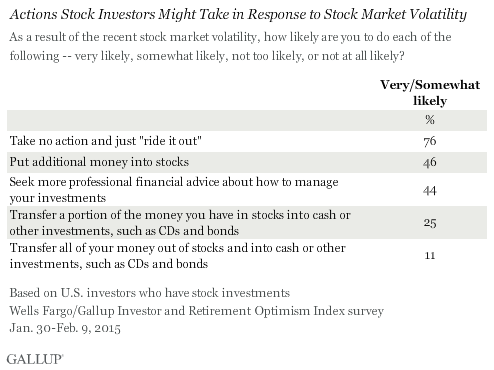
Indeed, a recent Gallup poll (h/t Ben Carlson at A Wealth of Common Sense) shows that the majority of investors today say they'll do nothing in the face of market volatility and nearly half said they'd put more money into stocks in the event of a sell off.


Of course, what investors say they'll do and what they'll actually do are two different things. (Everyone is a long-term investor when the market's going up, but we find out who really means it when the market falls.) However, the level of fear in the market seems to be rather low at the moment and that's not a great thing if you're looking to invest more into the market.

Does this mean you should do a 180 and become a daytrader? Absolutely not, but it does mean you should tighten rather than loosen your criteria for making a new investment. As one of Buffett's more famous sayings goes, "The less prudence with which other conduct their affairs, the greater prudence with which we should conduct our own affairs."

Related posts:
Stay patient, stay focused.

Best,

Todd


Subscribe to Clear Eyes Investing by Email


Saturday, February 21, 2015

How to Research Small Cap Dividend-Paying Stocks

The key turning point in my investment management career came when I concluded that because the notion of market efficiency has relevance, I should limit my efforts to relatively inefficient markets where hard work and skill would pay off best. - Howard Marks
A few years ago, my wife and I were vacationing on an island in North Carolina and spent some of our downtime combing the beaches for seashells. We weren't having much luck finding good specimens on the popular main beaches that were picked over by other tourists, so we decided to kayak to a more remote area of the island where the sea met the sound to see if that improved our fortunes.

Indeed it did. Within a few minutes on the less-traveled shoreline, we found better shells than we'd found in a few days on the popular beaches, including a relatively hard-to-find intact Scotch bonnet shell.

The Scotch bonnet: the state shell of North Carolina
There are clear parallels for us as investors. So much of the market's attention is focused on the largest companies that finding deeply undervalued companies among them is rare. Like patrolling the popular beaches for good shells, the only times you're likely to find treasure among large cap stocks is right after a storm when everyone is still taking shelter.

Few bargains today

This was very much the case in the years immediately following the financial crisis when many quality large caps were trading with attractive yields over 3%. Even as late as December 2011, the S&P Dividend Aristocrats Index, which consists of S&P 500 companies that have raised their payouts for at least 25 consecutive years, yielded 2.7%.

Unfortunately, the quality large-cap dividend beach is now as crowded as Panama City on spring break and deep values and attractive yields are thus harder to come by. Of the 53 current S&P Dividend Aristocrats, for instance, only 13 currently trade with dividend yields over 3%.

It's important to keep in mind that the universe of high-quality large cap dividend-paying stocks is relatively small. When we also consider that in the last two years alone, $39 billion flowed to dividend-themed ETFs (most of which are heavily large-cap focused) alone, it's easy to see how valuations have become stretched and yields depressed.

Where to look 

If your aim is to invest in the dividend stocks with best chance of outperforming in the coming years, your energy is best spent in areas of the market with less investor interest.

I'd start with sorting through a list of global smaller-cap dividend payers. As the following table from Royce Funds shows, there are not only a larger number of higher-yielding stocks to consider, but, as smaller companies, these names are less likely to be well-covered and are more likely to be mis-priced. (Of course, they can be mis-priced to the upside as well as the downside, so be sure to do your due diligence before investing.)

Source: Royce Funds
When evaluating small cap dividend-paying stocks, I look for the following attributes:
  1. Low debt or preferably no debt. More diversified larger firms can get away with having more financial leverage and can typically get better rates on their borrowings, whereas smaller companies tend to be more cyclical or more reliant on one product line, so a rock-solid balance sheet is a must-have for a smaller company that pays a dividend. 
  2. An invested leadership team. Unless they are founders themselves, executives at large companies are unlikely to own a meaningful percentage of the company. To own 1% of a $50 billion company, for example, would require an ownership stake of $500 million. Small cap executives, on the other hand, can more reasonably own a good stake of the business. With small caps, I like to see insiders own at least 5% of the company as it should motivate them to allocate capital with a long-term ownership perspective since they have skin in the game. 
  3. Steady free cash flow generation. This is always necessary when evaluating dividend-paying stocks as dividends must ultimately be funded by free cash flow in order to be sustainable. It's a particularly good sign when a small company is able to generate free cash flow across the business cycle. 
  4. Dominant in a profitable market niche. Small companies with dominant shares of niche markets are less likely to attract the attention of large competitors. In many cases, the niche is too small to make a difference for the large competitors and if the niche is attractive enough, the larger companies are more likely to simply acquire the dominant player instead of entering the market themselves. 
  5. Operates in a decidedly boring industry. I like to see a small company operating in an industry that's unlikely to attract investor attention  -- e.g. industrial parts, safety equipment, and food processing equipment. The longer the business can fly under investors' radars and not be of interest to potential competitors, the better. 
  6. A payout ratio below 50%. Small companies with a long growth runway should be reinvesting at least half their cash back into the business to fuel long-term dividend growth. A firm that is paying out much more than 50% of its earnings is likely in the mature or declining stage of its lifecycle. 
  7. Pricing power. If a company can steadily raise its prices on customers each year without losing a meaningful amount of business, it will go a long way toward supporting the current dividend payout and fueling dividend growth for years to come. If the company can't consistently raise prices, it probably doesn't have a durable competitive advantage and it therefore becomes more difficult for the company to protect margins and raise the dividend at a good pace each year. (If they're price-takers, make sure they are low-cost producers.) 
Researching smaller cap dividend-paying stocks requires a bit more legwork than researching large caps where information and analysis is more plentiful, but if you want a chance to beat the market by a meaningful margin over the longer-term, it's the right place for dividend-minded individual investors to spend a good chunk of our research time. 

Related posts
What I've been reading/watching this week:
Stay patient, stay focused.

Best,

Todd


Subscribe to Clear Eyes Investing by Email

Saturday, February 14, 2015

The Right Way to Approach New Investment Ideas

With most situations in life it pays to go into them expecting the best outcome. No one would take a Hawaiian vacation if they thought it would rain every day during their stay, no one would buy a house if their first thought was all the repairs they'd have to make in the coming years, and so on. 

With investing, however, it pays to approach new ideas with a healthy dose of skepticism. 

In a transcript of a 2008 interview with Buffett biographer, Alice Schroeder, she shared the following observation about Buffett's own process for evaluating new investment ideas:
The first step in Warren's investing process is always to say, "What are the odds that this business could be subject to any type of catastrophe risk - that could make it (the business fail)?...It is backwards the way most people think because most people find an interesting idea and figure out the math, they look at the financials, they do a project and then at the end, the (sic) ask, "What could go wrong." (author's emphasis)
Finding new investment ideas can be exciting, but our initial enthusiasm should be tempered until we've first determined the company is highly unlikely to have meaningfully-worse results in the coming years. By doing a "pre-mortem" on our stock ideas, we can save ourselves from making some big mistakes along the way. 

Dividend investors, for example, can ask "What would have to happen to make this company cut its dividend in the next 3-5 years?" More specifically, if the company currently covers its dividend twice over with earnings or free cash flow, you could ask, "What would have to happen for this company's earnings/free cash flow to be halved?" and thus put the dividend at risk

However you frame your questions, the key is to approach each idea with a safety-first mindset. Only then can we feel more confident in our subsequent findings. 

Related posts:
What I've been reading/listening to this week:
  • A lifetime of saving and investing helped a janitor amass an $8 million fortune - Reuters
  • Masters in Business podcast with StockTwits founder Howard Lindzon - Barry Ritholtz
  • Don't be a doomster - Monevator
  • Imitating genius - Matt Brice
  • What do low interest rates mean for stock returns - Ben Carlson
  • Michael Mauboussin on contrarian investing - via ValueWalk
  • A list of good financial bloggers and writers - Morgan Housel
Stay patient, stay focused.

Best,

Todd


Saturday, January 17, 2015

Preparing for the Next Bear Market

The opportunity to secure ourselves against defeat lies in our own hands, but the opportunity of defeating the enemy is provided by the enemy himself. - Sun Tzu
Earlier this week, a friend asked me what I thought could end this bull market. I searched for a smart answer and concluded that it was the one that investors haven't fully considered yet. Recalling my experience from the financial crisis, I said that it's always the punch you didn't see coming that knocks you out.

Keep an eye on your pic-a-nic baskets
Fearing this answer might be unsatisfactory, I floated a guess that there could be unforeseen consequences of falling oil prices.

There -- an answer more befitting an industry veteran.

The fact is, we have no idea what specific event or events will end this bull market, though it'll be obvious in hindsight, of course. Maybe someone will guess right, make leveraged bets on their thesis, make millions or billions and write a book about it, but for every one of those guys, there are legions who guessed wrong and are far worse off.

As long-term, business-focused investors, we shouldn't care much about what causes the next bear market. To borrow a phrase from Peter Lynch about macroeconomics, if you spend 13 minutes thinking about this, you've wasted 10 minutes. If anything, you're more likely to stress yourself out and make emotional trades in a quixotic mission to avoid your envisioned losses.

Rather than scramble to reposition your portfolio for the next bear market, we're much better off focusing on the things we can control. For one, look to learn more about the businesses we already own and the ones in which we've taken an interest.
  • How might a bear market impact management's current strategy?
  • If the current management team was in place during the financial crisis, how did they handle that challenge? Were they honest in their evaluation of the marketplace or did they try to put on a good face? 
  • Does management have a track record of making opportunistic acquisitions and investments (buybacks, etc.) in down markets?
  • Is the company's balance sheet prepared to handle a few lean years? 
  • Is the dividend well covered by both earnings and free cash flow?
By asking ourselves these types of questions now while the market is still strong, we'll be better prepared for when Mr. Market grows despondent again and offers us opportunities to invest in quality businesses at attractive prices. Indeed, it's only when Mr. Market makes such offers that we're able to sow the seeds of long-term market outperformance.

Related posts
What I've been reading/listening to this week
  • What Reese's peanut butter cups can teach us about investing -- Sova Group
  • The most under-appreciated investment skill is patience -- Time
  • Is investing really a zero sum game? -- Monevator
  • What makes for an exceptional company? -- CFO
  • Peter Lynch speech from 1994 -- YouTube
  • Understanding global capital allocation practices -- Michael Mauboussin 
  • A dozen things I've learned from Tom Murphy -- 25iq
The book I'm currently reading:
Stay patient, stay focused.

Best,

Todd


Thursday, January 1, 2015

Some Investing Advice for My Son

My wife and I recently welcomed our son into the world and, like any new parent, I've been thinking about all the things I'll need to teach him as he grows up -- how to ride a bike, how to read, and, of course, how to invest.

So with a few minutes to spare between diaper changes, I jotted down a few points for him to consider down the road if he ever wants to start managing his own money.

1. Learn from the masters, but think for yourself. By all means, read Warren Buffett, Peter Lynch, Ben Graham, and the writings of other successful investors, but remember that what worked for them may not work for you. Incorporate lessons from other investors with your own experience and develop a style that you're comfortable with.

2. Be an investor in businesses, not a trader of tickers. Invest in companies in which you want to be a long-term owner of the business. You have much better odds of identifying a good company than guessing where a stock's price will be in the next few months.

3. You can only grow the money that you keep. Minimize the costs of investing (commissions, fees, and taxes) by maintaining a long-term focus and not trading too often.

4. Stay emotionally balanced. Don't let the short-term movements of your stock prices determine your mood. You're never as good or as bad of an investor as you think -- just focus on becoming a better investor each day and the long-term returns will take care of themselves.

5. Keep it simple. Complex financial products and companies with hard-to-understand operations aren't worth your time and are probably over-priced anyway. Stick to what makes sense to you and aim to simplify your process.

6. Be insatiably curious. Read anything and everything. Some of the most valuable investing lessons you'll learn won't come from investing books. Philosophy, science, art, fiction, history, etc. all have something to offer, so always look to broaden your horizons. You'll be amazed at what you can tie back into your investing approach.

7. Only make investment decisions when you're calm and relaxed. When you're stressed, your mental time horizon shrinks and you struggle to see the big picture. Go for a walk, take some deep breaths, shoot some basketball in the driveway -- whatever it takes to regain the right perspective.

8. Invest for a greater purpose. Help yourself and help others. Investing isn't an end in itself, but is a means to an end. Use any money you don't need to be a blessing to others.

9. Be patient. The benefits of compounding interest are fully realized with time and time is on your side as an individual investor. Aim to hold your stock investments for at least three years, but ideally longer than that.

10. If you want to focus on nobler pursuits, invest using index funds. If you don't want to invest in individual companies, make sure that you're at least earning the market rate of return with your long-term savings. Invest in some low-cost total market funds, add money to them each month, and then see lesson #9.

What investing lessons have you shared with your own kids, nieces, nephews, etc.? Let me know in the comments section below or on Twitter @toddwenning.

What I've been reading/watching this week (short list this week):
Book I'm currently reading
Happy New Year!

Stay patient, stay focused.

Best,

Todd

Saturday, December 13, 2014

When to Throw in the Towel on a Stock

In Morgan Housel's excellent article, "If Other Industries Were Like Wall Street", he shares this satirical story: 
If we were as impatient about gardening as we are investing: Sam plants some seeds in his backyard. He checks back four hours later. Nothing. He digs them up and replants them. Four hours. Still nothing. A week later he is dismayed that he has no oak trees in his backyard. He calls oak trees a scam.
As Homer Simpson says, "It's funny 'cause it's true." 
Shoulda thrown in the towel. George Bellows' "Dempsey & Firpo"

It's equally irrational, however, to plant some seeds in the backyard, check back a decade later, see nothing sprouting from the ground, yet conclude an oak tree will eventually emerge. Something went wrong. 

At some point between the two extremes - four hours and a decade - it makes sense to throw in the towel on a stock that isn't performing and reinvest the capital elsewhere.

But how do we determine the right time? 

Here's Philip Fisher's opinion on the matter, from Developing an Investment Philosophy:
It was vital that I have some sort of quantitative check to be sure that I was right...With this in mind, I established what I called my three-year rule...
Whether I have been successful in the first year or unsuccessful can be as much a matter of luck as anything else...If I have a deep conviction about a stock that has not performed by the end of three years, I will sell it. If this same stock has performed worse rather than better than the market for a year or two, I won't like it. However, assuming that nothing has happened to change my original view of the company, I will continue to hold it for three years.  
Indeed, one of the "ground rules" of Warren Buffett's partnership was:
While I much prefer a five-year test, I feel three years is an absolute minimum for judging performance...If any three-year or longer period produces poor results, we all should start looking for other places to have our money. 
Three years seems like the right amount of time to give the market a chance to come around to your thesis. If that hasn't happened by the three year mark, your thesis was probably wrong. 

There's something to be said for taking the "coffee can" approach -- investing in a stock and then checking back on it many decades later. Fidelity reportedly ran a study, for instance, that found the group of its clients who had the best performance were those who forgot they had accounts at Fidelity.

If given the choice of doing nothing or trading my portfolio every month, I'd choose the do nothing approach. In practice, the ideal strategy is found somewhere in the middle. 

The key is that your decision-making rules are long term in nature and are approached with a patient, business-owner's mindset. A three-year rule for throwing in the towel on a poor investment is one such rule that we'd do well to implement in our process. 

This is the last Clear Eyes Investing post of 2014. Thank you very much for reading this year. Hoping you have a wonderful holiday season!

Related posts
What I've been reading/watching this week
Stay patient, stay focused.

Best,

Todd

Saturday, December 6, 2014

Paying Up For Quality Stocks

Price is what you pay, value is what you get. - Warren Buffett
A few years back, my wife and I were shopping around for a leather couch to put in our new home. As we walked around the showroom of a furniture store and had a look at some of the price tags for the couches, however, I realized our bank account would end up being a little lighter than I expected. Real leather couches don't come cheap.

Never eager to spend large amounts of money, my attention quickly turned to the faux leather options. Much to my delight, these were much cheaper. For a fraction of the price of a real leather couch, we could get the same size and design.

And besides, I reasoned, visitors wouldn't be able to tell the difference anyway. Why spend the extra money?

It seemed like a sweet deal at the time, but things have changed.

Today, my "deep value" couch is falling apart -- literally -- and I find myself back in the market for a new couch. Had I originally paid up for a high-quality leather couch, I probably wouldn't be in my current predicament. The poor man pays twice, indeed.

My mistake was this -- I only considered the price of the faux leather couch relative to the real leather couch without considering the prices relative to their respective quality.

As investors looking to buy stocks on the cheap, we often fall into the same trap -- we erroneously think a company with a lower multiple presents a better deal than one with a high multiple. While that may hold true when we're comparing two identical assets, the rule breaks down when we're comparing assets of different quality.

While the market isn't perfectly efficient, it is generally efficient, so more times than not tomorrow's great companies won't be found using a low price/earnings screen. If you want a chance to own a few of tomorrow's great companies, then, you'll need to eliminate your aversion to paying premium multiples.

As you might deduce from my story about couch shopping, this is something I've struggled with in my own portfolio. On a number of occasions, I've had a case of sticker shock and balked at investing in promising companies only to watch those stocks push higher as their competitive advantages, pricing power, and earnings growth more than justified their premium prices.

The risk with buying premium-multiple stocks is that today's premium-multiple will be tomorrow's average-multiple and your returns will be decimated by a re-rating. Reversion to the mean is a powerful force, of course.

As with any investment, it's critical to get a feel for the market's current expectations for the company and weigh them against your own. Equally important is the ability to tell the difference between a great company from an average company. If you're confident in your evaluation of both factors, you shouldn't shrink from paying up for quality stocks.

Related posts: 
What I've been reading/watching this week:
Stay patient, stay focused.

Best,

Todd

Saturday, November 8, 2014

The Art and Science of Investing

Stockpicking is both an art and a science, but too much of either is a dangerous thing...If you could tell the future from a balance sheet, then mathematicians and accountants would be the richest people in the world by now. - Peter Lynch, Beating the Street
The Astronomer, Vermeer
One of the traits shared by the investors I admire is an insatiable thirst for a wide range of knowledge. (Look no further than Charlie Munger on this point.) For every investing book they read, they might read two or three non-investing books if not more.

While it's absolutely critical to understand the science of investing -- accounting, valuation, analysis, etc. -- ultimately, the numbers reflected in a company's financial statement and the ones that go into our spreadsheets are by-products of human behavior. Without context, the numbers don't amount to much.

The art of investing is understanding why people do the things they do, especially the things we ourselves do. The better control we have over our own emotions and actions when other investors lack control, the better our returns should be in the long run. Further, it's important to read on a variety of topics as the market is a complex system and the more strings we can tie together, the greater our potential for identifying value-creating opportunities.

I'm curious to know what non-investing books you've read that have made a big impact on your investing strategy. You can let me know on Twitter @toddwenning or in the comments section below.

One of my recommendations is Tao Te Ching by Laozi (Lao Tzu), which has had a tremendous impact on my philosophy on patience, even if I don't always practice it as well as I should.

What I've been reading and listening to this week:
Stay patient, stay focused.

Best,

Todd

Saturday, November 1, 2014

What's Your Investing Edge?

Patience is bitter, but its fruit is sweet. - Rousseau
I recently attended the CFA Society of Chicago's annual dinner where a fellow attendee and I discussed how one of the more humbling things about going through the CFA Program, besides the difficulty of the curriculum and exams, is that you get a very real sense of the level of competition you face as an investor.

Depending on the location of your CFA test center, you could be taking the exam with over 1,000 other capable, well-educated, and motivated investment professionals, some of whom have flown in from overseas at their own expense because their country doesn't have a test center. Yep, that motivated.

You then realize the people you see are only a fraction of the global investment professionals with whom you're competing in the market every day.

We know that in order to produce different results from other investors you must have a different approach, but how to differentiate yourself amid such formidable competition isn't obvious.

This passage from the 1996 Berkshire Hathaway letter provides two solid options (my emphasis added):
Most investors, both institutional and individual, will find that the best way  to own common stocks is through an index fund that charges minimal fees. Those following this path are sure to beat the net results (after fees and expenses) delivered by the great majority of investment professionals.
    Should you choose, however, to construct your own portfolio, there are a few thoughts worth remembering.  Intelligent investing is not complex, though that is far from saying that it is easy.  What an investor needs is the ability to correctly evaluate selected businesses. Note that word "selected":  You don't have to be an expert on every company, or even many.  You only have to be able to evaluate companies within your circle of competence.  The size of that circle is not very important; knowing its boundaries, however, is vital.
To invest successfully, you need not understand beta, efficient markets, modern portfolio theory, option pricing or emerging markets.  You may, in fact, be better off knowing nothing of these.  That, of course, is not the prevailing view at most business schools, whose finance curriculum tends to be dominated by such subjects.  In our view, though, investment students need only two well-taught courses - How to Value a Business, and How to Think About Market Prices. 
    Your goal as an investor should simply be to purchase, at a rational  price, a part interest in an easily-understandable business whose earnings are virtually certain to be materially higher five, ten and twenty years from now. Over time, you will find only a few companies that meet these standards - so when you see one that qualifies, you should buy a meaningful amount of stock.  You must also resist the temptation to stray from your guidelines:  If you aren't willing to own a stock for ten years, don't even think about owning it for ten minutes. Put together a portfolio of companies whose aggregate earnings march upward over the years, and so also will the portfolio's market value.  
In other words, you can concede that you don't have an advantage over the market and build a diversified portfolio using low-cost index funds (which is a fine option), or you can aim to outperform by investing in businesses you understand, paying a good price for them, and holding them for the long-term. (Also see: A Simple Formula For Investing Success)

You could also do a little of both, of course, which is often called the "core and explore" or "core and satellite" approach.

The common thread, whichever strategy you choose, is patience and emotional self-control. As we've said here before, individual investors can't sustainably out-trade the institutions and that patience is the individual investor's greatest advantage over the market. We need to stick to our strengths.

Our efforts as individual investors would be put to better use if we focused on learning to analyze businesses and control our emotions -- buying when others are selling, doing nothing when others are trying to force returns, etc. -- rather than trying to outfox other investors in the short-term.

Though this is hard to do, I think it's the best way we can differentiate ourselves in the incredibly competitive marketplace of investors. To borrow a phrase from A League of Their Own, "It's supposed to be hard. If it wasn't hard, everyone would do it. The hard...is what makes it great."

What I've been reading & watching this week
Stay patient, stay focused.

Best,

Todd
@toddwenning on Twitter

Monday, September 1, 2014

Playing the Loser's Game

In a 1975 article in the Financial Analysts Journal entitled “The Loser’s Game”, Charles D. Ellis wrote:
Gifted, determined, ambitious professionals have come into investment management in such large numbers during the past 30 years that it may no longer be feasible for any of them to profit from the errors of all the others sufficiently often and by sufficient magnitude to beat the market averages.
Ellis concluded that the influx of smart and motivated people into the industry led to money management becoming a “loser’s game” -- a game in which you'd be crazy to compete and one that you should perhaps consider surrendering to (i.e. buy an index fund). Ellis recently reiterated this opinion in a recent article for the Financial Analysts Journal

Time to throw in the towel?

It's natural to read these comments and get discouraged about buying individual stocks, but Ellis's 1975 article offers a few excellent tips on how to not play the loser's game. 

1. Be sure you are playing your own game.

The individual investor’s advantage is not in trading. The hedge funds, mutual funds, and professional traders of the world simply have better data, more advanced trading platforms, and more financial incentive to focus on the short-term. The weekend investor doesn’t stand a chance versus this type of firepower, so trading is a game where the odds are stacked against the individual investor.

Staying patient, keeping a long-term mindset, and exploiting your advantages as an individual investor alters the playing field and improves your odds of success.

2. Keep it simple.

The less complicated your investment strategy, the better. As Ellis recommends, "Try to do a few things well." By focusing your efforts on one strategy -- whether it is based on dividends, small caps, deep value, etc -- and consistently sticking with it, you can more effectively tune out distractions and make better decisions. As a result, you'll keep trading costs down and give yourself the best opportunity to realize your return objectives. 

3. Concentrate on your defenses.

Ellis advocates improving your selling strategy because the market’s focus on buying makes it difficult to gain an edge on that side of the equation. It’s a fair point. 

To figure out how we might improve our selling strategy, let's consider the market's selling strategy.

While each investment firm has its own selling strategy, we know that the average mutual fund turnover ratio in recent years implies that, on average, stocks owned by funds have been held for just over one year.

Our key strength as individual investors lies in our ability to be patient, so our selling strategy should start with the idea of holding for at least three years and ideally five years or longer. Obviously if one of your stocks shoots well above your fair value estimate, it might be time to sell or trim the position, but on average we should look to hold for longer periods of time.

4. Don’t take it personally.

According to Ellis, the market turned into a loser's game precisely because investors’ "efforts to beat the market are no longer the most important part of the solution; they are the most important part of the problem." Resist the temptation to try harder for better returns. In fact, do just the opposite. This doesn’t mean you should pick stocks at random and buy and hold forever. Do your homework, of course, but be deliberate and patient, too. Let the market go through its phases of euphoria and despair and stay your course. Don't try to force returns.

Bottom line

Trying to beat the market in the short-run is a loser’s game if you make it your primary investment objective, so don’t play it. Instead, redefine the game. Establish your own objectives, stick to your strengths, and stay patient and when you look back at your returns five years from now, I think you'll like what you see. If you happen to beat the market, all the better.

For more on the "loser's game", a new multi-part video series by Sensible Investing addresses the topic and has a lined up a number of good interviewees. Here's the trailer.


What do you think? Let me know on Twitter @toddwenning

I've updated my Dividend Compass spreadsheet to fix a few bugs. You can download the updated version here

What I've been reading this week:


Stay patient, stay focused. 

Best,

Todd

A version of this post was published on April 14, 2012. It has been updated.