Showing posts with label stocks. Show all posts

Saturday, December 3, 2016

Moats and Knights

One of my favorite Warren Buffett quotes is a lesser-known one. It comes from a transcribed conversation he had with University of Maryland MBA students back in 2013, where he was asked about Morningstar's work on economic moats. 

Here's part of what he said:
If you have a castle in capitalism, people are going to try to capture it. You need 2 things – a moat around the castle, and you need a knight in the castle who is trying to widen the moat around the castle. 
Buffett disciples should be well familiar with his economic moat philosophy, but this was the first time I heard him use the metaphor of a "knight" widening the moat.

It's a great concept, isn't it? But this ideal combination of moat + knight is rarer than you might think.

First, the presence of a true economic moat is by definition an infrequent occurrence in capitalism. Right off the bat, then, we can eliminate a majority - 75%-plus - of companies from moat + knight contention.

Second, let's think about what Buffett means by "widening the moat." He lays out his definition in the 2005 Berkshire letter to shareholders:
Every day, in countless ways, the competitive position of each of our businesses grows either weaker or stronger. If we are delighting customers, eliminating unnecessary costs and improving our products and services, we gain strength. But if we treat customers with indifference or tolerate bloat, our businesses will wither. On a daily basis, the effects of our actions are imperceptible; cumulatively, though, their consequences are enormous. 
When our long-term competitive position improves as a result of these almost unnoticeable actions, we describe the phenomenon as “widening the moat.” And doing that is essential if we are to have the kind of business we want a decade or two from now. We always, of course, hope to earn more money in the short-term. But when short-term and long-term conflict, widening the moat must take precedence. 
This is a tall order for any executive to achieve - delight customers, cut costs, all while investing in the business - particularly when that executive has to meet Wall Street's quarterly expectations. Focusing on short-term operational performance is one thing, but if a CEO or CFO is overly concerned about how investors might react to 90 days worth of performance, they aren't concurrently focused on widening the moat.

Unfortunately, that eliminates even more companies from moat + knight contention.

Third, management must be in it for the long haul and they must love the business. Note that in the above quote, Buffett is talking about building a stronger business decades from now. In stark contrast, there are far too many mercenary executives today with great resumes who are in their roles to maintain the status quo, collect big paychecks, get a car allowance and country club membership, and look the part. Executives with one eye on the door do not make good knights. Or squires for that matter.

One of my favorite college basketball players growing up was Xavier University's Brian Grant, who was drafted by the Sacramento Kings in 1994. I remember reading that when Grant was asked how much he wanted to be paid, he said $2.50, "enough for a Dr. Pepper and a bag of chips." The guy just wanted to play basketball at the highest level*. If you find that kind of passion in a CEO or CFO, you might have found yourself a knight.

Finally, management must have a knack for capital allocation. I've been fortunate in my career to speak with a lot of different companies and I've learned that the ones who truly "get it" regarding capital allocation are few and far between. Sure, there are plenty of teams that can keep the trains running on time (and plenty who can't!). The ones who have a clear and repeatable process, however, for reinvesting capital (internally or through M&A), returning cash to shareholders, and making their companies tougher to compete with are unusual.

So what are we left with? Maybe 5% of all companies having a moat + knight combination? It might even be lower than that. Whatever the rate may be, the key takeaways are:

  1. The moat + knight combination is a powerful one.
  2. Moats are rare.
  3. Knights are rare.
  4. Moats + knights are extremely rare. 
  5. When you think you've found a moat + knight combination trading at a reasonable price, be sure to capitalize on the opportunity.
Stay patient, stay focused.

Best,

Todd
@toddwenning 


*Despite his low first offer, Grant made $808,000 in 1994.

The opinions expressed here are the author's and not those of his employer. For a full disclaimer, please click here. 


Saturday, April 4, 2015

Signs of a Perfect Stock

Peter Lynch's chapter in One Up on Wall Street describing the signs of a "perfect stock" was one of the most influential to my early investing career because it steered my attention away from the water cooler stocks I'd typically hear about and toward underfollowed, niche companies that operated in decidedly unglamorous industries.

As I've developed my own style of investing, I've come up with my own list of company traits that I like to look for when researching a new stock. I have yet to find a company that checks off all ten boxes, granted, but if the company possesses at least two attributes, it makes me sit up and take notice.

1. Management and directors have significant skin in the game. One of the first things I check into when researching a company is how much stock management and the board members own. With smaller companies, I like to see executives and directors as a group owning at least 5% of the company, as they'll will be less likely to take undue risks with shareholder capital and more likely to think like owners because they are in fact owners. With larger companies where high-percentage ownership is less realistic, insiders should still own enough where the stock's long-term performance has a material impact on their own net worth.

I particularly like to see companies, like Sun Hydraulics (SNHY), pay their board members solely in stock grants with long-term vesting as this increases the likelihood that the board's interests will be aligned with those of long-term shareholders.

2. Its employee turnover is well-below industry average. Having to frequently train new employees is not only negative on the income statement, but the company also loses valuable institutional memory with the departure of each employee. One of the many reasons that Costco (COST) has stood apart from other retailers is that its employee turnover (6% in 2014) is far below the retail industry average. Diamond Hill Investment Group (DHIL) has had zero turnover (at least as of 2013) in its equity portfolio manager and research analyst group since the firm was founded.

3. It's headquartered in a smaller town. This may seem trivial, but I like to see companies based far outside of major financial centers as I think they're more likely to fly under Wall Street's radar, can afford to take a longer-term perspective, and have employees with a better work/life balance (less traffic, affordable housing, etc.).

4. It has a great corporate culture that reinforces its competitive advantages. See: Don't Overlook This Factor in Your Research Process

5. It makes products that can't be (easily) disrupted by technology. If a start-up in Silicon Valley or a teenager in her garage is looking for ways to challenge a company's business model, eventually they'll find a way. That's why I prefer to own companies that make products that aren't likely to change or be disrupted anytime soon (knock on wood), like Douglas Dynamics' (PLOW) snow plows or WD-40's (WDFC) eponymous oil-based spray.

6. It pays a regular dividend and pays special dividends in good years. After particularly strong years, well-run companies often find themselves flush with cash. While this is a good problem to have, it can become a bad problem if management misallocates the capital by pursuing growth-for-growth's sake acquisitions and overpaying for them. Paying special dividends shrinks management's sand box and allows them to focus on only reallocating the capital that can earn high long-term returns.

7. It approaches buybacks opportunistically. Most companies I've come across approach buybacks as a way to return excess cash to shareholders without regard to the value of the shares they're buying back. As such, I like to see a company with a cogent and disciplined buyback strategy like U.K. retailer, Next (NXT.L). Such companies should, over time, create value for long-term shareholders.

8. It prefers to grow organically rather than through aggressive acquisitions. A company that's willing to start from scratch in new markets and build the business slowly and in the manner they want shows me that they're willing to take a long-term approach.

9. It communicates plainly with shareholders. See: 5 Signs of a Good Annual Report

10. It has a meaningful recurring revenue stream. One of the best investments I've made was in a healthcare equipment company called Kinetic Concepts, also known as KCI, which was acquired in 2011. KCI makes negative-pressure wound therapy equipment for healing difficult-to-treat wounds, and the great thing about their business model was they lease or sell the equipment and sell the one-use dressing kits that needed to be changed out during treatment. The disposable product sales provided KCI with a steady recurring revenue stream that gave me added confidence to buy the stock in November 2008 at a time when the market in turmoil.

What company attributes do you look for? Let me know on Twitter @toddwenning or in the comments section below.

*I own shares of Douglas Dynamics, Sun Hydraulics, Diamond Hill, and WD-40. A list of my current holdings can be found here. 

Related posts:


Happy Easter!

Stay patient, stay focused.

Best,

Todd


Subscribe to Clear Eyes Investing by Email


Saturday, March 28, 2015

Has Long-Term Investing Become Too Popular?

Long-term investing has gotten so popular it's easier to admit you're a crack addict than to admit you're a short-term investor. - Peter Lynch in 2000
Having publicly written about investing since 2006, it's been interesting to observe changing investor opinion on long-term investing.

In the years following the financial crisis, for example, I would routinely receive reader comments and emails saying that long-term investing was flawed. And to be fair, they had numbers on their side, as ten-year trailing returns for the S&P 500 were unimpressive. As late as 2010, investors in the S&P 500 were looking back at a "lost decade" with negative ten-year total returns.

It was easy to see why investor patience was in short supply. Even though the starting point of that ten-year period was the beginning of the end for the tech bubble, ten years is still a long time to wait for positive returns.

What a difference a few years of steady market gains makes. Since starting this blog three years ago and writing about the benefits of long-term investing, I have yet to receive any pushback on whether or not long-term investing works.

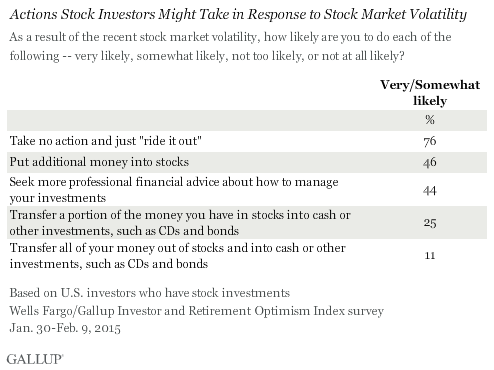
Indeed, a recent Gallup poll (h/t Ben Carlson at A Wealth of Common Sense) shows that the majority of investors today say they'll do nothing in the face of market volatility and nearly half said they'd put more money into stocks in the event of a sell off.


Of course, what investors say they'll do and what they'll actually do are two different things. (Everyone is a long-term investor when the market's going up, but we find out who really means it when the market falls.) However, the level of fear in the market seems to be rather low at the moment and that's not a great thing if you're looking to invest more into the market.

Does this mean you should do a 180 and become a daytrader? Absolutely not, but it does mean you should tighten rather than loosen your criteria for making a new investment. As one of Buffett's more famous sayings goes, "The less prudence with which other conduct their affairs, the greater prudence with which we should conduct our own affairs."

Related posts:
Stay patient, stay focused.

Best,

Todd


Subscribe to Clear Eyes Investing by Email


Saturday, March 7, 2015

Lessons From Buffett's Tesco Mistake

As I read through the 2014 Berkshire Hathaway letter last weekend, one section stood out to me as being full of great investing lessons.

Here's the passage: 
Attentive readers will notice that Tesco, which last year appeared in the list of our largest common stock investments, is now absent. An attentive investor, I’m embarrassed to report, would have sold Tesco shares earlier. I made a big mistake with this investment by dawdling.
At the end of 2012 we owned 415 million shares of Tesco, then and now the leading food retailer in the U.K. and an important grocer in other countries as well. Our cost for this investment was $2.3 billion, and the market value was a similar amount. 
In 2013, I soured somewhat on the company’s then-management and sold 114 million shares, realizing a profit of $43 million. My leisurely pace in making sales would prove expensive. Charlie calls this sort of behavior “thumb-sucking.” (Considering what my delay cost us, he is being kind.) 
During 2014, Tesco’s problems worsened by the month. The company’s market share fell, its margins contracted and accounting problems surfaced. In the world of business, bad news often surfaces serially: You see a cockroach in your kitchen; as the days go by, you meet his relatives. 
While it was nice to hear Buffett's thoughts on his mistake with Tesco, I was surprised that he started the story at year-end 2012, as it's important to consider the full timeline of the investment.

Buffett started his position in 2006 and owned 3% of the company by the end of that year. At the time, Tesco was led by CEO Terry Leahy who, over a 14-year tenure, more than quadrupled the company's pre-tax profits and its store count. The company set its sights on international expansion in the U.S. and Asia and established a dominant share of the U.K. grocery market. Things were looking up for the business.

In June 2010, however, Leahy surprised the market by announcing his retirement. He was replaced by lifelong Tesco employee and head of international operations, Phil Clarke. 

Tesco struggled over the next eighteen months, as the U.S. operations floundered and U.K. discount grocers began chipping away at Tesco's market share on its home turf. And despite a profit warning after a bad 2011 Christmas trading season, Buffett increased his stake in Tesco to 5.2% in January 2012. Many observers, including yours truly, thought that this investment amounted to a vote of confidence in Tesco management and its business prospects. 

Around the same time, however, Neil Woodford, a well-known UK fund manager, announced he had sold his entire Tesco stake after owning shares for the better part of 20 years. He also laid out a compelling case for why Tesco had lost its way, wasn't practicing smart capital allocation, and was battling structural headwinds.

I point this out to illustrate that there were some well-founded and known concerns about Tesco's management and competitive advantages -- two core components of Buffett's investment philosophy -- in early 2012. I would be interested to know at what point between his increased investment in 2012 and when he began to "sour" on management in 2013 that Buffett began to rethink his Tesco thesis. 

Here are some of the key lessons I take from Buffett's Tesco mistake:
  • Every investor makes mistakes. Even Buffett. The key is to recognize them, correct them as quickly as possible, and learn from them. 
  • CEO changes matter. When a very successful CEO retires or leaves a company, it's time to reassess your investment thesis. Specifically, it's important to figure out the quality of the hand the new CEO has been dealt (i.e. how strong is the business?) and the skill with which the new CEO can play the hand (i.e. how strong is the CEO at capital allocation?) 
  • Doing nothing is doing something. It's important to be patient, of course, but even though you may not be buying or selling a stock, you're still making an active choice to hold. If you have concerns about key points in your thesis, doing nothing and hoping the problem goes away on its own isn't a good strategy.
What I've been reading this week:
Stay patient, stay focused.

Best,

Todd


Subscribe to Clear Eyes Investing by Email

Saturday, February 21, 2015

How to Research Small Cap Dividend-Paying Stocks

The key turning point in my investment management career came when I concluded that because the notion of market efficiency has relevance, I should limit my efforts to relatively inefficient markets where hard work and skill would pay off best. - Howard Marks
A few years ago, my wife and I were vacationing on an island in North Carolina and spent some of our downtime combing the beaches for seashells. We weren't having much luck finding good specimens on the popular main beaches that were picked over by other tourists, so we decided to kayak to a more remote area of the island where the sea met the sound to see if that improved our fortunes.

Indeed it did. Within a few minutes on the less-traveled shoreline, we found better shells than we'd found in a few days on the popular beaches, including a relatively hard-to-find intact Scotch bonnet shell.

The Scotch bonnet: the state shell of North Carolina
There are clear parallels for us as investors. So much of the market's attention is focused on the largest companies that finding deeply undervalued companies among them is rare. Like patrolling the popular beaches for good shells, the only times you're likely to find treasure among large cap stocks is right after a storm when everyone is still taking shelter.

Few bargains today

This was very much the case in the years immediately following the financial crisis when many quality large caps were trading with attractive yields over 3%. Even as late as December 2011, the S&P Dividend Aristocrats Index, which consists of S&P 500 companies that have raised their payouts for at least 25 consecutive years, yielded 2.7%.

Unfortunately, the quality large-cap dividend beach is now as crowded as Panama City on spring break and deep values and attractive yields are thus harder to come by. Of the 53 current S&P Dividend Aristocrats, for instance, only 13 currently trade with dividend yields over 3%.

It's important to keep in mind that the universe of high-quality large cap dividend-paying stocks is relatively small. When we also consider that in the last two years alone, $39 billion flowed to dividend-themed ETFs (most of which are heavily large-cap focused) alone, it's easy to see how valuations have become stretched and yields depressed.

Where to look 

If your aim is to invest in the dividend stocks with best chance of outperforming in the coming years, your energy is best spent in areas of the market with less investor interest.

I'd start with sorting through a list of global smaller-cap dividend payers. As the following table from Royce Funds shows, there are not only a larger number of higher-yielding stocks to consider, but, as smaller companies, these names are less likely to be well-covered and are more likely to be mis-priced. (Of course, they can be mis-priced to the upside as well as the downside, so be sure to do your due diligence before investing.)

Source: Royce Funds
When evaluating small cap dividend-paying stocks, I look for the following attributes:
  1. Low debt or preferably no debt. More diversified larger firms can get away with having more financial leverage and can typically get better rates on their borrowings, whereas smaller companies tend to be more cyclical or more reliant on one product line, so a rock-solid balance sheet is a must-have for a smaller company that pays a dividend. 
  2. An invested leadership team. Unless they are founders themselves, executives at large companies are unlikely to own a meaningful percentage of the company. To own 1% of a $50 billion company, for example, would require an ownership stake of $500 million. Small cap executives, on the other hand, can more reasonably own a good stake of the business. With small caps, I like to see insiders own at least 5% of the company as it should motivate them to allocate capital with a long-term ownership perspective since they have skin in the game. 
  3. Steady free cash flow generation. This is always necessary when evaluating dividend-paying stocks as dividends must ultimately be funded by free cash flow in order to be sustainable. It's a particularly good sign when a small company is able to generate free cash flow across the business cycle. 
  4. Dominant in a profitable market niche. Small companies with dominant shares of niche markets are less likely to attract the attention of large competitors. In many cases, the niche is too small to make a difference for the large competitors and if the niche is attractive enough, the larger companies are more likely to simply acquire the dominant player instead of entering the market themselves. 
  5. Operates in a decidedly boring industry. I like to see a small company operating in an industry that's unlikely to attract investor attention  -- e.g. industrial parts, safety equipment, and food processing equipment. The longer the business can fly under investors' radars and not be of interest to potential competitors, the better. 
  6. A payout ratio below 50%. Small companies with a long growth runway should be reinvesting at least half their cash back into the business to fuel long-term dividend growth. A firm that is paying out much more than 50% of its earnings is likely in the mature or declining stage of its lifecycle. 
  7. Pricing power. If a company can steadily raise its prices on customers each year without losing a meaningful amount of business, it will go a long way toward supporting the current dividend payout and fueling dividend growth for years to come. If the company can't consistently raise prices, it probably doesn't have a durable competitive advantage and it therefore becomes more difficult for the company to protect margins and raise the dividend at a good pace each year. (If they're price-takers, make sure they are low-cost producers.) 
Researching smaller cap dividend-paying stocks requires a bit more legwork than researching large caps where information and analysis is more plentiful, but if you want a chance to beat the market by a meaningful margin over the longer-term, it's the right place for dividend-minded individual investors to spend a good chunk of our research time. 

Related posts
What I've been reading/watching this week:
Stay patient, stay focused.

Best,

Todd


Subscribe to Clear Eyes Investing by Email

Saturday, February 7, 2015

A Fresh Look at the Simple Formula

Earlier this week, a reader* of the blog had a look at the formula I laid out in "A Simple Formula for Investing Success" and cleverly suggested that the formula should be rearranged from:


Investment + Good Company + Right Price + Patience

to...

Good Company + Right Price + Investment + Patience

How did I miss that? 

Clearly, "GRIP" is much more memorable than "IGRP", and more importantly, it's the correct order of operations when investing. I don't know many successful investors who invest first and learn about the company later. 

So while we're on this topic, let's review the formula in the proper order.

Good company: Continuously learning about the business over the life of the investment is an essential component to investing success. Initially, your focus should be on determining whether or not the company possesses durable competitive advantages (i.e. an economic moat), what it's growth runway looks like, the skill with which management allocates shareholder capital, the company's culture, the strength of its financials, and so on.  

Even after you've invested in the company, it's important to stay on top of these items and review the business's progress at least twice a year. After a few years of following a business, you'll be surprised how much of an expert you'll become on its operations relative to the average investor, which itself, in turn, becomes an advantage.

Right price: Even a good company can make for a bad investment if you overpay for it, so it's important to consider valuation before making any investment. That said, investing is about dealing with uncertainty and no valuation model will be perfect. In my experience, the simpler the model, the better. Each investor has his or her own approach to valuation, but the key is to get a feel for the range of potential valuation outcomes and look to invest when you think the market price provides a suitable margin of safety. 

Investment: This may seem to be an obvious point, but I have a feeling that most of us have done a lot of research in a company, liked what we saw, but failed to actually make the investment for one reason or another. 

I know I've done that before, the most painful example being Tractor Supply (TSCO) in March 2009 -- a company I failed to invest in even after doing extensive due diligence and liking what I saw. As the market began to rapidly recover from the depths of the financial crisis, I got cold feet and waited for a pullback that never came. The stock's since gone up over 1,000% and has been the costliest mistake of my investing career. The lesson here is that investing success is impossible unless money is actually put to work.

Patience: If you've followed through with the first three steps -- you have a good company, think it's trading at the right price, and make an investment -- the only thing left to do is be patient. Patience, of course, also happens to be the hardest part of the formula, but it's critical to give the business a chance to compound your capital over time. 

Bottom line

Following this simple formula is far from easy; however, if you can consistently apply it over a long investing career, I truly believe it will produce very satisfactory results indeed. 


*Many thanks to Dev at the Stable Investor blog in India for pointing this out!  

Quote of the week:


What I've been reading/watching this week:
Stay patient, stay focused.

Best,

Todd


Saturday, December 13, 2014

When to Throw in the Towel on a Stock

In Morgan Housel's excellent article, "If Other Industries Were Like Wall Street", he shares this satirical story: 
If we were as impatient about gardening as we are investing: Sam plants some seeds in his backyard. He checks back four hours later. Nothing. He digs them up and replants them. Four hours. Still nothing. A week later he is dismayed that he has no oak trees in his backyard. He calls oak trees a scam.
As Homer Simpson says, "It's funny 'cause it's true." 
Shoulda thrown in the towel. George Bellows' "Dempsey & Firpo"

It's equally irrational, however, to plant some seeds in the backyard, check back a decade later, see nothing sprouting from the ground, yet conclude an oak tree will eventually emerge. Something went wrong. 

At some point between the two extremes - four hours and a decade - it makes sense to throw in the towel on a stock that isn't performing and reinvest the capital elsewhere.

But how do we determine the right time? 

Here's Philip Fisher's opinion on the matter, from Developing an Investment Philosophy:
It was vital that I have some sort of quantitative check to be sure that I was right...With this in mind, I established what I called my three-year rule...
Whether I have been successful in the first year or unsuccessful can be as much a matter of luck as anything else...If I have a deep conviction about a stock that has not performed by the end of three years, I will sell it. If this same stock has performed worse rather than better than the market for a year or two, I won't like it. However, assuming that nothing has happened to change my original view of the company, I will continue to hold it for three years.  
Indeed, one of the "ground rules" of Warren Buffett's partnership was:
While I much prefer a five-year test, I feel three years is an absolute minimum for judging performance...If any three-year or longer period produces poor results, we all should start looking for other places to have our money. 
Three years seems like the right amount of time to give the market a chance to come around to your thesis. If that hasn't happened by the three year mark, your thesis was probably wrong. 

There's something to be said for taking the "coffee can" approach -- investing in a stock and then checking back on it many decades later. Fidelity reportedly ran a study, for instance, that found the group of its clients who had the best performance were those who forgot they had accounts at Fidelity.

If given the choice of doing nothing or trading my portfolio every month, I'd choose the do nothing approach. In practice, the ideal strategy is found somewhere in the middle. 

The key is that your decision-making rules are long term in nature and are approached with a patient, business-owner's mindset. A three-year rule for throwing in the towel on a poor investment is one such rule that we'd do well to implement in our process. 

This is the last Clear Eyes Investing post of 2014. Thank you very much for reading this year. Hoping you have a wonderful holiday season!

Related posts
What I've been reading/watching this week
Stay patient, stay focused.

Best,

Todd

Saturday, December 6, 2014

Paying Up For Quality Stocks

Price is what you pay, value is what you get. - Warren Buffett
A few years back, my wife and I were shopping around for a leather couch to put in our new home. As we walked around the showroom of a furniture store and had a look at some of the price tags for the couches, however, I realized our bank account would end up being a little lighter than I expected. Real leather couches don't come cheap.

Never eager to spend large amounts of money, my attention quickly turned to the faux leather options. Much to my delight, these were much cheaper. For a fraction of the price of a real leather couch, we could get the same size and design.

And besides, I reasoned, visitors wouldn't be able to tell the difference anyway. Why spend the extra money?

It seemed like a sweet deal at the time, but things have changed.

Today, my "deep value" couch is falling apart -- literally -- and I find myself back in the market for a new couch. Had I originally paid up for a high-quality leather couch, I probably wouldn't be in my current predicament. The poor man pays twice, indeed.

My mistake was this -- I only considered the price of the faux leather couch relative to the real leather couch without considering the prices relative to their respective quality.

As investors looking to buy stocks on the cheap, we often fall into the same trap -- we erroneously think a company with a lower multiple presents a better deal than one with a high multiple. While that may hold true when we're comparing two identical assets, the rule breaks down when we're comparing assets of different quality.

While the market isn't perfectly efficient, it is generally efficient, so more times than not tomorrow's great companies won't be found using a low price/earnings screen. If you want a chance to own a few of tomorrow's great companies, then, you'll need to eliminate your aversion to paying premium multiples.

As you might deduce from my story about couch shopping, this is something I've struggled with in my own portfolio. On a number of occasions, I've had a case of sticker shock and balked at investing in promising companies only to watch those stocks push higher as their competitive advantages, pricing power, and earnings growth more than justified their premium prices.

The risk with buying premium-multiple stocks is that today's premium-multiple will be tomorrow's average-multiple and your returns will be decimated by a re-rating. Reversion to the mean is a powerful force, of course.

As with any investment, it's critical to get a feel for the market's current expectations for the company and weigh them against your own. Equally important is the ability to tell the difference between a great company from an average company. If you're confident in your evaluation of both factors, you shouldn't shrink from paying up for quality stocks.

Related posts: 
What I've been reading/watching this week:
Stay patient, stay focused.

Best,

Todd

Saturday, November 15, 2014

When Should You Sell a Good Stock?

With the market riding high again, you might be thinking about selling a few holdings and reinvesting the cash when stocks have fallen again.

Buy low, sell high. That's the idea, right?

But before you hit the sell button, consider Philip Fisher's answer to the question, "Should an investor sell a good stock in the face of a potentially bad market?" 
Even if the stock of a particular company seems at or near a temporary peak and that a sizable decline may strike in the near future, I will not sell the firm's shares provided I believe that its longer term future is sufficiently attractive... 
My belief stems from some rather fundamental considerations about the nature of the investment process. Companies with truly unusual prospects for appreciation are quite hard to find for there are not too many of them. However, for someone who understands and applies sound fundamentals, I believe that a truly outstanding company can be differentiated from a run-of-the-mill company with perhaps 90 percent precision.
It is vastly more difficult to forecast what a particular stock is going to do in the next six months...For these reasons, I believe that it is hard to be correct in forecasting the short-term movement of stocks more than 60 percent of the time no matter how diligently the skill is cultivated. This may well be too optimistic an estimate. 
So, putting it in the simplest mathematical terms, both the odds and the risk/reward considerations favor holding. 
It's a point worth re-emphasizing. You have much higher odds of identifying a truly outstanding company than guessing how that company's stock will perform in the next six months. Play the odds accordingly.

Lesson learned...hopefully

I haven't always followed this advice. In April 2006, I bought shares of Core Laboratories (CLB), a high-quality and advantaged oil & gas services company, for a split-adjusted price near $26. Two years later, with oil prices near record highs, I sold the stock near $58 and patted myself on the back for a job well done.

Don't pull out your flowers and water your weeds.
(Photo taken at Kew Gardens by my wife. Nice, huh?)
I felt particularly good about my decision during the financial crisis when oil prices plunged and Core Labs fell back around $30.

Had I capitalized on my sheer luck and bought back into Core Labs after it dipped, this story might have had a happier ending, but alas I did not.

In fact, my portfolio's subsequent returns would have been markedly better had I done nothing at all. Fast forward to today and Core Labs is trading at $139 and was up to almost $200 earlier this year.

Now, it's possible that I'm looking back at this case with a serious case of hindsight bias, but my selling decision in 2008 wasn't due to a lower opinion of Core Labs' business or its management. Instead, I wanted to lock in my 123% gain after a strong run in oil prices. Not a terrible decision, of course, but not a good one either.

To see how it's supposed to work, fund manager Chuck Akre* said in an interview earlier this year that his firm has owned shares of Markel (MKL) for over 20 years and that they didn't sell during down times. During that 20+ year timeframe, according to Akre, Markel's book value per share increased 14% annualized and its stock price has grown at least at the same rate.

If you're playing at home, those kind of annualized returns will turn a $10,000 investment into just under $140,000 over 20 years.

Bottom line

While there are some good reasons to sell a stock, trading in and out of great companies in an effort to time the stock price is not one of them. Pressing the pause button on compounding can be hazardous to your wealth.

What do you think? Let me know on Twitter @toddwenning.

Related posts:
What I've been reading/watching this week:

Stay patient, stay focused.

Best,

Todd
*I own shares of Akre Focus Fund


Saturday, October 25, 2014

How I Got Started in Investing

Working hard is important. But there is something that matters even more, believing in yourself. Think of it this way; every great wizard in history has started out as nothing more than what we are now, students. If they can do it, why not us? -- Harry Potter
The title of the first page I opened to was, "What is a stock?"

I had no idea.

It was the summer of 2003, I'd just graduated from college and was reading through a Series 6 license study guide that Vanguard sent me a few weeks before my start date. All the financial lingo I came across as I flipped through the study guide was intimidating to say the least. 

"I might have made a mistake," I thought. I might be out of my league with this job.

I was a history major in college, and even though I minored in economics, I had no clue about finance and investments. To illustrate, a neighbor who heard I was hired by Vanguard said to me, "Oh, we own some of their mutual funds. It's a really good company."

I nodded along with her, but I confess that I still wasn't entirely sure what a mutual fund was. I needed to learn a lot. In a hurry.

The telephone game

Before taking the job at Vanguard, I was deciding between a career in law or in teaching -- the typical paths for history majors.

Investing, however, was something I knew I needed to learn about and I figured I'd try working in the industry for a year or two before going to law school. At the very least, I'd leave the industry knowing what to do with my money, so I applied to a few financial firms near Philadelphia.

Vanguard was hiring entry-level registered representatives and they liked that I had experience managing a call center during college. My break was that I knew how to talk on a phone. The finance stuff, they must have figured, they could teach me. 

(With hindsight, I realize how lucky I was to start my investing career at a firm that preached things like focusing on the long term, insisting on low costs, and staying the course. If I'd started my career at a commission-based firm or one with front-loaded funds, things might be different.)

Into the fire

It was a steep learning curve. After a few weeks of training, I was on the phone speaking with 40 or more clients a day about mutual funds, placing trades, and walking through IRA transfer forms. While it wasn't exactly the job I'd envisioned as an idealistic recent graduate, speaking with such a broad group of individual investors was great training.

After a year on the mutual fund side, I moved over to brokerage and was introduced to equity investors. My first day on that job, someone called and asked for the current quote for Microsoft. I asked him, "What's the ticker?" Click. Guy hung up. That's how green I was with stocks. 

Working in brokerage was my first real meeting with Mr. Market and the emotions that drive short-term stock swings. The busiest day I had in brokerage, for example, was not on some good economic news or during tax season -- it was when Howard Stern announced he was joining Sirius Satellite Radio. No one cared about price, they just wanted to buy. 

Lessons learned

My first two years in the industry were a tremendous learning experience and those early lessons have stuck with me in the nine years since. Here are some of them:
  1. Few people have a strong understanding about investing and many people are intimidated by it.
  2. Learning how to invest is not easy and requires a lot of time, interest, and dedication.
  3. Most people are aware of the first two points and want someone they can trust to help them achieve their goals so they can focus on other things. 
  4. Investing and money management is an emotional business. The account balance isn't just a number -- it represents someone's life savings and is a by-product of their labor. The financial professional's job should be to help the person manage those emotions and make prudent investment decisions.
  5. There's always something you don't know about investing. It's a never-ending education.
Getting started in investing can be overwhelming, but it's important to remember that everyone has to start somewhere and no one is born a natural investor. The critical thing is to stay confident and never stop learning. 

What I've been reading & watching
Stay patient, stay focused.

Best,

Todd

Friday, September 5, 2014

An Important Dividend Cut Case Study

Back in March, I explained why I sold my position in Tesco for a 22% loss.

Looks like it was the right move. As of this writing, the stock is down another 25% from my selling price. Worse, the company recently reduced its interim dividend by 75%.

Double whammy

By no means was I the first to highlight trouble at Tesco and plenty of observers have offered reasons for the company's decline. My focus here will be on the dividend.

Frankly, I'm still a bit stunned at how Tesco's turned out and think its dividend cut serves an important case study for dividend investors to review.

Consider that in fiscal year 2011 (year-end February 2011) Tesco increased its dividend by 10.8% -- marking an impressive 27 consecutive years of dividend increases. Well-respected long-term investors like Neil Woodford and Warren Buffett held considerable positions in Tesco and its UK market share was over 30%. All seemed to be right.

The board and management also appear to have been very confident in the future of the business, otherwise they wouldn't have increased the dividend at such a high rate in fiscal 2011.

With the exception of a financial crisis-scenario, rarely does a company have such a sharp reversal in dividend policy. Yet that's exactly what happened at Tesco. 

In fiscal year 2012, the dividend grew just 2.1%. The next year, it was held flat and stayed at that rate until it was finally cut in August 2014.

Source: Company filings
The company's dividend health, as measured by the Dividend Compass, was also deteriorating.


While some warning signs were present, the combination of Tesco's distinguished dividend track record, its real estate holdings, and its leading share of the UK grocery market remained for some compelling reasons to hold and hope for a dividend turnaround.

Yet the numbers didn't lie. Tesco's dividend health slowly worsened, the dividend yield steadily increased to more than twice the UK market average (usually a good sign that something's wrong), and it was only a matter of time before the board needed to make some tough decisions. 

Lessons learned

The first takeaway from Tesco's dividend cut is a reminder that no dividend is risk-less or sacrosanct. In the UK market, Tesco was a core holding in many dividend portfolios (including mine for a while) and up until a few years ago its payout was about as much of a sure thing as one could expect. Yet in a matter of three years Tesco went from dividend aristocrat to dividend plebian. If worse comes to worse, the board can always cut the company's dividend.

Second, it's critical to not "buy and forget" your investments. I know some well-intentioned dividend strategies advocate this approach and while I certainly appreciate the value of patience and keeping trading costs to a minimum, what happened with Tesco serves as an example of why some level of maintenance research is needed if you hope to avoid dividend cuts.

The combination of a permanent capital loss and a dividend cut can have a material impact on your longer-term income returns and you'll have less capital to reinvest in another dividend-paying stock. If you can catch a dividend cut early, you have much higher odds of preserving more of your capital.

Third, no matter how strong the company's dividend track record, if the numbers don't add up, it pays to be skeptical. Admittedly, I held onto Tesco a little too long thinking that it would simply take some time for the company to right the ship. When in doubt, preserve capital.

Fourth, while most dividend-focused portfolios are diversified, the Tesco share price decline and dividend cut is a reminder that it's important not to rely on any one stock (or one sector) to generate a large percentage of your dividend income.  

Finally, even if you're a patient investor, it's important to establish some selling rules. For example, one rule might be that if a company's dividend growth trajectory radically changes for the worse or is altogether halted, it's time to sell. In such a situation, it's highly likely that company leaders have changed their opinion about the company's ability to generate higher levels of cash flow.

What do you think? Let me know on Twitter @toddwenning

What I've been reading this week
Stay patient, stay focused.

Best,

Todd


Monday, September 1, 2014

Playing the Loser's Game

In a 1975 article in the Financial Analysts Journal entitled “The Loser’s Game”, Charles D. Ellis wrote:
Gifted, determined, ambitious professionals have come into investment management in such large numbers during the past 30 years that it may no longer be feasible for any of them to profit from the errors of all the others sufficiently often and by sufficient magnitude to beat the market averages.
Ellis concluded that the influx of smart and motivated people into the industry led to money management becoming a “loser’s game” -- a game in which you'd be crazy to compete and one that you should perhaps consider surrendering to (i.e. buy an index fund). Ellis recently reiterated this opinion in a recent article for the Financial Analysts Journal. 

Time to throw in the towel?

It's natural to read these comments and get discouraged about buying individual stocks, but Ellis's 1975 article offers a few excellent tips on how to not play the loser's game. 

1. Be sure you are playing your own game.

The individual investor’s advantage is not in trading. The hedge funds, mutual funds, and professional traders of the world simply have better data, more advanced trading platforms, and more financial incentive to focus on the short-term. The weekend investor doesn’t stand a chance versus this type of firepower, so trading is a game where the odds are stacked against the individual investor.

Staying patient, keeping a long-term mindset, and exploiting your advantages as an individual investor alters the playing field and improves your odds of success.

2. Keep it simple.

The less complicated your investment strategy, the better. As Ellis recommends, "Try to do a few things well." By focusing your efforts on one strategy -- whether it is based on dividends, small caps, deep value, etc -- and consistently sticking with it, you can more effectively tune out distractions and make better decisions. As a result, you'll keep trading costs down and give yourself the best opportunity to realize your return objectives. 

3. Concentrate on your defenses.

Ellis advocates improving your selling strategy because the market’s focus on buying makes it difficult to gain an edge on that side of the equation. It’s a fair point. 

To figure out how we might improve our selling strategy, let's consider the market's selling strategy.

While each investment firm has its own selling strategy, we know that the average mutual fund turnover ratio in recent years implies that, on average, stocks owned by funds have been held for just over one year.

Our key strength as individual investors lies in our ability to be patient, so our selling strategy should start with the idea of holding for at least three years and ideally five years or longer. Obviously if one of your stocks shoots well above your fair value estimate, it might be time to sell or trim the position, but on average we should look to hold for longer periods of time.

4. Don’t take it personally.

According to Ellis, the market turned into a loser's game precisely because investors’ "efforts to beat the market are no longer the most important part of the solution; they are the most important part of the problem." Resist the temptation to try harder for better returns. In fact, do just the opposite. This doesn’t mean you should pick stocks at random and buy and hold forever. Do your homework, of course, but be deliberate and patient, too. Let the market go through its phases of euphoria and despair and stay your course. Don't try to force returns.

Bottom line

Trying to beat the market in the short-run is a loser’s game if you make it your primary investment objective, so don’t play it. Instead, redefine the game. Establish your own objectives, stick to your strengths, and stay patient and when you look back at your returns five years from now, I think you'll like what you see. If you happen to beat the market, all the better.

For more on the "loser's game", a new multi-part video series by Sensible Investing addresses the topic and has a lined up a number of good interviewees. Here's the trailer.


What do you think? Let me know on Twitter @toddwenning. 

I've updated my Dividend Compass spreadsheet to fix a few bugs. You can download the updated version here. 

What I've been reading this week:


Stay patient, stay focused. 

Best,

Todd

A version of this post was published on April 14, 2012. It has been updated.