Showing posts with label dividend portfolio. Show all posts

Friday, September 5, 2014

An Important Dividend Cut Case Study

Back in March, I explained why I sold my position in Tesco for a 22% loss.

Looks like it was the right move. As of this writing, the stock is down another 25% from my selling price. Worse, the company recently reduced its interim dividend by 75%.

Double whammy

By no means was I the first to highlight trouble at Tesco and plenty of observers have offered reasons for the company's decline. My focus here will be on the dividend.

Frankly, I'm still a bit stunned at how Tesco's turned out and think its dividend cut serves an important case study for dividend investors to review.

Consider that in fiscal year 2011 (year-end February 2011) Tesco increased its dividend by 10.8% -- marking an impressive 27 consecutive years of dividend increases. Well-respected long-term investors like Neil Woodford and Warren Buffett held considerable positions in Tesco and its UK market share was over 30%. All seemed to be right.

The board and management also appear to have been very confident in the future of the business, otherwise they wouldn't have increased the dividend at such a high rate in fiscal 2011.

With the exception of a financial crisis-scenario, rarely does a company have such a sharp reversal in dividend policy. Yet that's exactly what happened at Tesco. 

In fiscal year 2012, the dividend grew just 2.1%. The next year, it was held flat and stayed at that rate until it was finally cut in August 2014.

Source: Company filings
The company's dividend health, as measured by the Dividend Compass, was also deteriorating.


While some warning signs were present, the combination of Tesco's distinguished dividend track record, its real estate holdings, and its leading share of the UK grocery market remained for some compelling reasons to hold and hope for a dividend turnaround.

Yet the numbers didn't lie. Tesco's dividend health slowly worsened, the dividend yield steadily increased to more than twice the UK market average (usually a good sign that something's wrong), and it was only a matter of time before the board needed to make some tough decisions. 

Lessons learned

The first takeaway from Tesco's dividend cut is a reminder that no dividend is risk-less or sacrosanct. In the UK market, Tesco was a core holding in many dividend portfolios (including mine for a while) and up until a few years ago its payout was about as much of a sure thing as one could expect. Yet in a matter of three years Tesco went from dividend aristocrat to dividend plebian. If worse comes to worse, the board can always cut the company's dividend.

Second, it's critical to not "buy and forget" your investments. I know some well-intentioned dividend strategies advocate this approach and while I certainly appreciate the value of patience and keeping trading costs to a minimum, what happened with Tesco serves as an example of why some level of maintenance research is needed if you hope to avoid dividend cuts.

The combination of a permanent capital loss and a dividend cut can have a material impact on your longer-term income returns and you'll have less capital to reinvest in another dividend-paying stock. If you can catch a dividend cut early, you have much higher odds of preserving more of your capital.

Third, no matter how strong the company's dividend track record, if the numbers don't add up, it pays to be skeptical. Admittedly, I held onto Tesco a little too long thinking that it would simply take some time for the company to right the ship. When in doubt, preserve capital.

Fourth, while most dividend-focused portfolios are diversified, the Tesco share price decline and dividend cut is a reminder that it's important not to rely on any one stock (or one sector) to generate a large percentage of your dividend income.  

Finally, even if you're a patient investor, it's important to establish some selling rules. For example, one rule might be that if a company's dividend growth trajectory radically changes for the worse or is altogether halted, it's time to sell. In such a situation, it's highly likely that company leaders have changed their opinion about the company's ability to generate higher levels of cash flow.

What do you think? Let me know on Twitter @toddwenning

What I've been reading this week
Stay patient, stay focused.

Best,

Todd


Thursday, June 12, 2014

The Danger of Having an Absolute Dividend Yield Target

I think it is possible to deliver a 4 per cent yield and to deliver dividend growth, going forward, but as I say, you must never allow an income target to dictate what you own. - Neil Woodford (UK fund manager)

In this low interest rate era, the demand for current income remains strong -- particularly among those living on a fixed income.

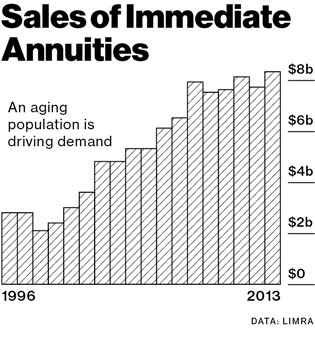
Indeed, sales of immediate annuities recently hit a record, even though the buyers are effectively locking in low rates for the life of the contract.

Due to this demand, a common question you’ll read on various dividend-focused message boards is some variant of:

“I need to construct a dividend portfolio that yields (some unreasonable %). What stocks should I buy to achieve this?”

At first glance, it might seem a reasonable approach -- simply buy a few stocks with yields that meet your target yield, and then sit back and watch the cash flow in.

Putting the cart before the horse

As Woodford noted in the aforementioned quote, however, it’s never a good idea to start with an income target - especially a high one - and work backward as it can open up a number of longer-term risks.

To see why, let's say you wanted to build a portfolio with a current yield of 6% today...

1. Increased sector concentration: To achieve such a high yield right now, you'd need to anchor the portfolio in investments like royalty trusts, energy MLPs, and REITs -- and speculative ones at that. The market’s higher-yielding stocks are typically clustered in a few slower-growth (e.g. utilities), troubled, or speculative sectors. For example, such a strategy would have put you into a lot of bank stocks pre-financial crisis. If one thing goes wrong in the sector, your portfolio could be wiped out.

2. Increased risk: At present, the average yield on the S&P 500 is about 2%. When a stock is yielding more than 2x this average - particularly in a period of strong demand for dividend stocks - the market isn't likely pricing in much growth. For ultra-high yields, the market might even price in a dividend cut.


3. Skews your selection process: When you've set an absolute dividend yield target that's far above the market average, you're no longer focused on doing thorough research and building a portfolio of good (and well-bought) companies that can sustain and raise their payouts over time. Instead, your sole focus is on dividend yield and the other important factors are rationalized away.

What to do instead

A better alternative to setting a high and absolute yield target is to set up a relative one like, "at least 25% above the market average." In addition, establish a target dividend growth rate such as, "grow annual income more than 3 percentage points above inflation."

That way you aren't fighting the market while getting above average income, you'll find more quality companies to consider, and you can maintain a longer-term focus (i.e. balancing current and future income).

Stay patient, stay focused.

Best,

Todd
@toddwenning on Twitter


Friday, January 17, 2014

Where to Find Differentiated Dividend Ideas

Most dividend strategies focus on larger firms with good balance sheets and a long track record of making uninterrupted and rising dividend payouts.

Assuming you pay good-to-fair prices for stocks that fit these criteria, you can most certainly build a solid income-producing portfolio. The problem is that such companies -- the “aristocrats” or “achievers” as they’re often called -- are a relatively scarce asset.

Think about it -- a teenager might be able to build the next great app or social media platform, but it will likely take decades of success before that company is able to generate consistent free cash flow. The Pfizers, Kimberly-Clarks, and Diageos of the world were not built overnight. 

Thousands of companies are listed on the U.S. market, but only 54 companies are included in the S&P 500 Dividend Aristocrats (25+ years of consecutive dividend increases), 85 companies are held in the broader SPDR S&P Dividend ETF (25+ years of consecutive dividend increases), and 212 are held in the PowerShares Dividend Achievers ETF (10+ years of consecutive dividend increases).

A scarce asset indeed.

Given the limited supply of such companies and the added interest in higher-yielding stocks over the last three years, finding values in this space has been understandably difficult.

So if you’re looking for new dividend ideas in today’s market, or in any market for that matter, don’t forget to search for companies in these four areas, which typically don’t show up in common dividend screens.

1. Firms that have cut their dividend

I realize this is borderline heresy in the income investing world and I’ve generally guided against investing in firms that have cut their dividend payout within the last five years, but it’s worth investigating each cut on a case-by-case basis.

Why did the company cut its payout? If it was one of the 1,000+ U.S.-listed companies that cut their dividend during the financial crisis, for example, there may have been a genuine concern for liquidity following an ill-timed acquisition or investment made in 2007 or 2008 that leveraged the balance sheet at the wrong time. In other words, the decision may not have been based on the board’s long-term outlook but on a short-term concern.

Dow Chemical and General Electric, for example, have more than doubled their payouts post-dividend cut, and though they have yet to fully rebound to pre-cut levels, investors who bought after the cut certainly aren't complaining today.

While most dividend cuts come after a sustained period of poor operating performance, some firms slash their payouts ahead of poor operating performance or if there's a need to retain cash for reinvestment needs. 

In fact, a 2007 study by Bulan, Subramanian, and Tanlu found:
A significant number of dividend omissions are actually good news, signaling a turnaround in the fortunes of the omitting firms after a period of poor performance...we find that good omitters have stronger fundamentals at the time of omission - they have higher profitability and lower levels of debt overhang.
Of course you want to avoid owning a stock prior to a dividend cut, but once the deed is done, there's no harm in having a look. The key is to determine whether or not the underlying business remains solid (i.e. does it have a moat?) and if the lower dividend payouts can actually improve the business's fortunes.

2. Firms that are in the final stages of a deleveraging process

An indebted company that’s currently in a deleveraging process may not pass dividend screens that have low-debt requirements. If the company is generating large amounts of free cash flow, however, it may reallocate that free cash toward dividend growth once the deleveraging process is complete. 

When considering a dividend-paying stock with above-average debt, have a look through the company’s recent filings, conference call transcripts, and presentations to determine if it’s aggressively reducing debt at the moment. If the company is struggling to pay down debt, pass on the idea, but if it is paying down debt and approaching its target leverage ratios, it may be primed for dividend growth in the near future.

3. Small caps

A good number of dividend strategies prefer larger stocks due to their perceived safety (i.e. more financial resources and lower chance of going bust) and avoid smaller cap firms when searching for ideas. While I wouldn’t advocate a dividend portfolio consisting solely of small caps, there are plenty of smaller firms with good competitive positions, solid balance sheets, and a distinguished dividend track record that I would consider just as steady as large firms. Plus, small caps often have longer growth runways than their larger peers. As such, they shouldn’t be overlooked.

4. Spin-offs

Screens that require a long dividend history won’t pick up recent spin-offs, yet these can be great opportunities -- not just on a dividend basis, but also on a value basis as they tend to have less initial analyst coverage and institutional interest. 

These firms also tend to be in good financial health. As Peter Lynch wrote in One Up on Wall Street:
“Large parent companies do not want to spin off divisions and then see those spinoffs get in trouble, because that would bring embarrassing publicity that would reflect back on the parents. Therefore, the spinoffs normally have strong balance sheets and are well prepared to succeed as independent entities.”  
Lists of upcoming and recent spin-offs are easily found online (here’s one). Not all spin-offs make for good dividend holdings, so I suggest focusing on the parent’s dividend record and philosophy, the composition of the new board (are they from the parent company?), and the new company’s recent free cash flow history.

To illustrate, when Philip Morris International was spun-off of Altria in early 2008, it began trading with a dividend yield near 4% and has since more than doubled its payout. With hindsight it's easy to see that PMI was an attractive idea, of course, but it didn’t take a great leap in logic at the time of the spin-off to conclude that despite the new company’s lack of dividend history that it would likely follow its parent’s philosophy about raising dividends (Altria has increased its dividend 47 times in the last 44 years).

Bottom line

The secret is out about high quality large caps with long dividend track records and there simply aren't enough of them to buy at good prices today. If you want differentiated dividend ideas and want to achieve differentiated results, don't forget to comb these four areas of the market.

Good reads this week
Quote of the week

"We aim above the mark to hit the mark." - Emerson

Best,

Todd
@toddwenning on Twitter


Saturday, October 19, 2013

An Easy Mistake Made by Dividend Investors

Dividend investing can seem deceptively easy. If you want to generate, say, a 5% yield from your dividend portfolio, you only need to buy a group of stocks that provide a weighted average yield of 5%. Then just sit back and watch the money roll in.

Or so the thinking goes.

And, yes, you may indeed receive your desired dividend income if you follow this strategy, but constructing a portfolio in this manner without attention to valuation could end up costing you in the longer-term.

Consider two investors that each invested $100,000 in dividend portfolios with 5% starting yields. Over the course of ten years each investor realizes annual dividend growth of 3%. The first investor (blue line) bought stocks that were considerably overvalued and subsequently lost 20% in capital value in year one; alternatively, the other (red line) invested in stocks that were undervalued and gained 20% in capital value in year one.

After the year one corrections to fair value, both portfolios grow at 8% per year through year 10.


At the end of ten years, both portfolios generated the same amount of dividend income ($57,319), but their ending capital values are nearly $80,000 apart ($159,920 vs. $239,880). It's hard to imagine that the two investors would feel equally good about their performance even though they realized equal dividend income over the ten year period.

To further my point, if both investors decided to liquidate their dividend portfolios in year 10 and invested their capital in bonds with 5% coupons, the first investor would receive annual payments of $7,996 while the second investor would receive $11,994 per year until maturity.

This is an admittedly simple example, but it illustrates an important point about the hidden costs of not paying attention to valuation in income investing. Ultimately, capital growth matters.

Valuation avoidance (Photobucket)
Whether you use relative valuation methods (i.e. comparing P/E ratios, etc.) or absolute valuation methods (i.e. dividend discount models, discounted cash flow models, etc.), the important thing is to fully consider the price you're paying and the value you're getting from each investment. Get to know the businesses you'd like to invest in, understand what drives their performance, and don't rely on a single metric -- in this case, dividend yield -- to guide your buying decisions.

Good dividend investing eschews complexity, but that doesn't mean it's supposed to be easy.

Good reads this week

Quote of the week
A mildly non-conventional investment approach, emphasizing a business approach to security selection, gives some opportunity for long-term results slightly above average without corresponding increase in investment risk. - Warren Buffett
If you think this article may be of interest to a friend or colleague, feel free to forward it, and let me know if you have any questions about topics discussed. 

Best,

Todd 
@toddwenning

Thursday, October 10, 2013

Better Buying Opportunities Coming for Dividend Investors

In 2005, I distinctly recall perusing the Barnes & Noble business section for a book on dividend investing, only to find just one book that specifically addressed the topic. (There are, um, quite a few more available today on Amazon.com.)

Things changed with the financial crisis, as we know. Interest rates plunged and dividend stocks rapidly became an attractive alternative for income-seeking investors. 


Indeed, the Google Trends chart for the search term “dividend stocks” illustrates the changes in sentiment from 2004 to present quite nicely:


Source: Google Trends

Naturally, the financial services industry responded to strong investor demand for dividends by launching dividend-themed ETFs, ETNs, and funds to attract assets. Some are more creative than others, but when there's a revenue-weighted dividend ETF (not kidding), you know folks are running out of ideas.

Fortunately, it seems we're past the "peak" for dividend valuations, investor interest appears to be turning elsewhere, and more long-term buying opportunities could thus present themselves.

"Non-dividend stocks have outperformed dividend stocks in the S&P 500 over a one year timeframe. Prior to this period, nonpayers had underperformed dividend stocks since late 2009."  - FactSet Dividend Quarterly, September 2013
Just this week, in fact, I started a position in Coca-Cola -- my first buy this year for the dividend sleeve of my portfolio -- and found it interesting that the stock was yielding over 3% for the first time since 2010. 

Though low interest rates may be around a little longer, the prospect of rising interest rates in the coming years should at least limit further multiple expansion for higher-yielding dividend stocks. In the event of a market pull-back and considering the robust dividend growth we've seen in the last three years, I would expect to see more quality 3% to 5% yields coming available. 

Stay focused and patient out there.

Best,

Todd
@toddwenning

Good reads this week


Quote of the Week
"My father was very sure about certain matters pertaining to the universe. To him, all good things -- trout as well as eternal salvation -- come by grace and grace comes by art and art does not come easy." -- Norman Maclean, "A River Runs Through It" 

Saturday, September 21, 2013

The Ten Points of Income Investing

1. Income investing is a separate and distinct strategy

It's not growth, it's not value -- income comes first. (See: The Income Investor's Manifesto)

2. Discipline and patience are behavioral prerequisites 

Great dividend-producing portfolios are built over decades, not weeks and months. It's critical to keep short-term market moves in perspective. (See: Making Each Investment Count)

3. Insist on owning dividend-paying companies with economic moats

You'll save yourself a lot of trouble if you own firms with durable competitive advantages. Read this book to learn how to recognize an economic moat.

4. Keep transaction costs to a minimum

Ideally below 1% per year. Remember: you can only compound what you keep.

5. Beware of unrealistic yields

If a yield seems too good to be true, it probably is. There might be something wrong with a stock that carries a yield more than twice the index average. (See: Ultra High Yield = Ultra High Risk)

6. Don't be afraid to sell, but do so for the right reasons

Trading and income investing don't mix. Take an investor's perspective and aim to hold for at least three years. (See: A Simple Guide for Selling Stocks)

7. Have a dividend reinvestment strategy

How you manage the regular cash flows from your dividend portfolio can have a tremendous impact on your long-term returns. (See: 5 Keys for Reinvesting Dividends)

8. Think globally, but be mindful of extra costs 

There are great dividend opportunities in foreign markets, but be aware of possible withholding taxes in the company's home country.

9. Stay away from companies drowning in debt

Companies with too much debt become beholden to creditors and the dividend can come under pressure if the creditors aren't satisfied.

10. Take a portfolio perspective

A dividend strategy isn't comprised of one or two stocks, but rather a group of stocks assembled to achieve specific objectives and goals. (See: 5 Rules for Building a Dividend-Focused Portfolio)

What do you think? Any points to add? Please let me know in the comments section below.

Best,

Todd
@toddwenning on Twitter

Friday, June 7, 2013

Backtesting and Dividend ETFs

Each week it seems a new dividend ETF strategy comes across my Twitter feed. I'm not surprised, of course -- the financial sector will always be quick to strike when the iron's hot -- but it bears repeating that investors should be careful before buying a dividend ETF.

But why is that? One reason is that the strategies of many new dividend ETFs rest on newly-minted indexes based primarily on backtested data. Invariably they show how the strategy has outperformed a peer group in the past, but continued outperformance is far from assured.

In fact, a 2012 study by Vanguard looked at the performance of newly-created indexes for ETFs and found something quite telling:
"The index average for all the indexes outperformed the broad stock market at an annualized rate of 10.31% as measured by five years of back-filled data, but underperformed at an annualized rate of –0.93% over the five years following the index live date."
Source: Vanguard
Even more concerning is that the median time between index creation and ETF launch was just 77 days (down from 3 years in 2000). Two and a half months hardly seems enough time to ensure an index truly reflects the strategy it is meant to track.

The problem for the ETF industry is that it takes about five years for a strategy to show whether or not it is truly effective. Thankfully for them, backtesting is a quick and simple marketing salve.

Don't believe the hype

I've been skeptical of dividend-themed ETFs (and ETNs) that are based on backtested strategies for a number of years now. Some are better than others, but there are four key reasons to approach them with caution.

1. Piling on.  If a backtested strategy is indeed profitable and its creators are confident in its ability to outperform in the future, you'd think they'd want to keep it to themselves, right?

Once a worthy strategy is shared with a larger audience, however, investors naturally pile on and what alpha there might have been will dissipate -- especially if the strategy is easily replicated. As such, it's critical to ask yourself the following: "Why is this strategy being sold to me? And if it's so great, why aren't they keeping it to themselves?" If you can't answer those questions, look elsewhere.

2. Selling history. Past performance is not a guarantee of future returns. Reversion to the mean is a part of investing and what's worked in recent years stands a strong chance of underperforming in the next few years, and vice versa. Few ETF marketing departments will find it easy to sell a strategy that's underperformed even if it is primed to do well in the future.

3. Dynamic markets. One of the ways to learn chess is to start with end-games and work in reverse. The reason this is possible is that the rules of chess and the chessboard are static. The market is much more dynamic and investing environments change over time, making forward-looking strategies based on historical strategies all the more unreliable.

Case in point is the performance of some WisdomTree's dividend ETFs during the financial crisis. Their strategies were backtested with forty years of data (1964 to 2005) -- a fair amount of data -- but that period of time didn't encounter anything like we saw in 2008 and 2009. WisdomTree's dividend-weighted strategy simply didn't work the way it was intended when hundreds of stocks cut their dividend payouts.

4. Shoddy statistics. Lazy statistical research can lead to false (and dangerous) conclusions. Most of the backtested index presentations that I've seen are missing critical pieces of information that allow the investor to independently determine whether or not the results are statistically significant (ANOVA tables, etc.). If this type of information is not available, it's cause for concern.

Bottom line

Dividend ETFs with exciting strategies supported by backtested data seem a quick and easy way to get exposure to dividend stocks, but be careful not to buy into a strategy that may have already passed its "sell by" date or one that heavily depends on a certain type of market environment to prosper.

Ultimately, I believe investors are better served by methodically and patiently building their own dividend portfolio rather than buying a dividend ETF. To get started, here are my five keys for building a dividend portfolio and Dividend Compass tool to help you identify stocks with sustainable dividend payouts.

For more on this topic:

Looking in the Rear-View Mirror: The Perils of Data Snooping via +Stockopedia 
FINRA’s Wrongheaded Ruling On Backtesting via +IndexUniverse 
Joined at the Hip: ETF and Index Development via +Vanguard

Any questions or comments? Please post them below. Stay patient out there and have a great weekend!

Best,

Todd
@toddwenning


Saturday, January 26, 2013

The Most Dangerous Time to Pick High-Yield Stocks

The most dangerous time to pick high-yield stocks is in the late stage of a bull market, which I believe we're in today.

One of the oldest investment adages is that "bull markets climb a wall of worry" and that has certainly been true of this market. Despite all the various crises -- Greece, the Eurozone, fiscal cliffs, debt ceilings, Manti Te'o's girlfriend, etc. -- many major global markets are at or near five-year highs. 


From a dividend investor's perspective, however, it's precisely the worry that provides the opportunities to buy quality high-yield shares -- defined loosely here as companies with strong balance sheets, plenty of dividend cover, a good track record of raising dividend payouts, and sustainable competitive advantages -- at discounted prices.


As markets rally and the worry dissipates, however, dividend yields naturally go in the opposite direction and the number of good opportunities dries up.


Quality rallies early

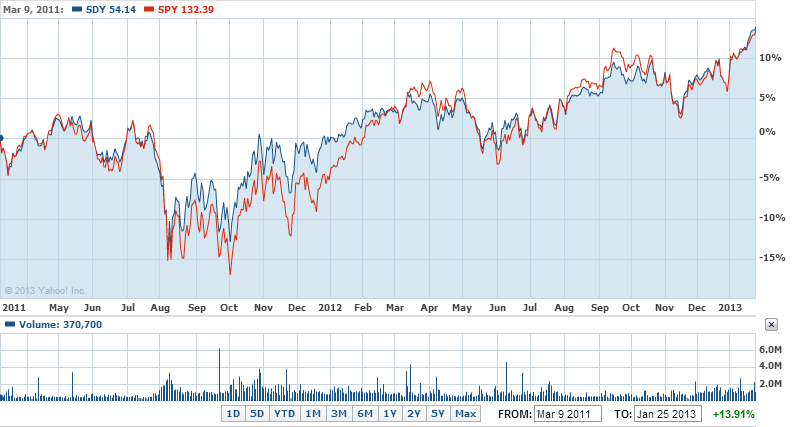
Consider the performance of the SPDR S&P Dividend ETF (SDY) -- which tracks the S&P High Yield Dividend Aristocrats Index -- versus the SPDR S&P (SPY) since the nadir of the financial crisis.


Source: Yahoo! Finance
Just about neck-and-neck over the period, but let's take a look at how they performed in the two years after the low-point in the market:

Source: Yahoo! Finance
For most of this two year period, the SDY steadily outperformed the index. Eventually, however, the index caught up and they've been trading pretty much in-line ever since:

Source: Yahoo! Finance
Though the S&P High Yield Dividend Aristocrats Index may not be the perfect tracker of "quality" dividend stocks, I do consider it a fair proxy. As such, we can gather from this example that quality dividend payers got snapped up fairly quickly in this bull market. By early 2011, the Aristocrats index was likely trading at or near fair value.

Once the quality names have been picked up in the early stages of a bull market, investors looking for a combination of high-yield and quality are normally left needing to compromise one for the other.

This isn't to say there aren't special cases for investors to pick up quality high-yield names at a discount during a bull market -- markets can also overreact to a bad earnings report or temporary sector concerns -- but, as a whole, quality high-yield names are normally snapped up early on.

Scraping the bottom of the barrel

When examining a high-yield stock in this type of market, it's imperative to examine why the stock's yield remains well above the market average. If it possesses market-average risk and growth potential, it stands to reason that its yield should also approximate the market average and that investors should have bid up the stock price by now. If its current yield is still 2x the market average, then, it's probably a good indication that something is wrong with the underlying business -- either it has considerable risk factors or its growth outlook is quite meager. In either case, it probably can't be defined as a "quality" dividend payer.

To further illustrate this concept, let's step into the way-back machine for a moment and travel back to early 2008, near the end of the previous bull market. At the end of 2007, the S&P 500 average dividend yield was 1.89% putting any stock over 3.8% firmly into the high-yield category (my rule-of-thumb is 2x the market average in the U.S.).

I was able to find a helpful table of the highest-yielding Dow 30 stocks as of January 24, 2008 and examine their subsequent five-year dividend growth rates.

Source: CNBC.com, Yahoo! Finance; Altria dividend growth as of June 2008, post-PM spin off.
The dividend-based performance of these shares since the end of the last bull market is certainly mixed, with Altria being the stand-out star, especially when you factor in the performance of Philip Morris International over the period. AT&T and Verizon did reasonably well, too, but you certainly got what you paid for -- high-yield and low dividend growth. As for Pfizer, Citigroup, and GM...the numbers speak for themselves. 

A look at the highest-yielding stocks in the S&P 500 from around the same time is even more troubling, with a number of famous dividend blow-ups found therein. 

Granted, a good percentage of the 1,000+ dividend cuts by U.S. companies in 2008 and 2009 were financials and I don't expect another massive round of dividend cuts in the near future, but the principle holds true that investors should be very skeptical of the highest-yielding stocks in the late stages of a bull market as the "margin of safety" has shrunk considerably.

A cautionary tale

If you've already built your dividend-focused portfolio, this may be a good time to review the highest-yielding names in your portfolio, but it isn't necessarily a screaming sell signal if you have a long time horizon and can afford to be patient. On the other hand, if you're starting to build a dividend-focused portfolio right now or are looking to add new names to your portfolio, proceed with caution when considering high-yield stocks.

As always, thanks for reading and please post any comments below or on our dividend investing community page on Google Plus.

Best,

Todd
@toddwenning on Twitter


Saturday, October 6, 2012

Where to Find Value in the Dividend Market Today

There's no question that dividend-paying stocks have become more popular in recent years as interest rates on fixed income and savings products declined.

Indeed, dividend-focused ETFs and mutual funds have experienced strong inflows, some higher-yielding stocks in rather staid industries (tobacco, utilities, etc.) are trading with multiples above their five-year averages, and gross S&P 500 dividend distributions will almost certainly hit a record high in 2012.

Contrarian investors will naturally raise an eyebrow or two at these developments.

Time to bail?

The heightened interest in dividends has led to some speculation that a "dividend bubble" might be afoot. As you might expect, massive debate has ensued among pundits, normally with the author taking a firm and uncompromising stance on one side or the other.

The problem isn't that either side hasn't made fair observations, but that the debate is all too frequently framed around whether or not there is in fact a "bubble" -- definitely the most overused term in financial media -- and misses the fruitful middle ground, leaving the reader without any actionable guidance ("Great, there is/isn't a dividend 'bubble'. What now?")

Instead, I find it far more instructive to critically examine the landscape as it stands today without being handcuffed to the bubble framework.

Is there "irrational exuberance" for dividend-paying stocks today? Relative to the exuberance we saw with dotcom stocks or housing, absolutely not. If there were, I don't think you'd see this trend in U.S. payout ratios.

Aswath Damodaran, Standard & Poors
It stands to reason that if investors really were falling over themselves to buy dividend stocks, companies would respond by paying out a greater percentage of earnings as dividends, so as to attract more investor interest. While some companies may have accelerated their dividend payouts for this reason, on average, that's not happening.

Instead, S&P 500 companies used buybacks over dividends to return cash to shareholders by nearly a 2:1 ratio in the second quarter. The trailing 12-month S&P 500 dividend payout ratio stands at just 32%.

Source: Standard & Poors

Might some institutional investors be using buybacks to 'create' their own dividends? Maybe, but you could have just as easily have made the case for that in 2007 when dividends certainly weren't in style.

And yes, aggregate dividends of $67.31 billion in Q2 2012 set a record -- finally eclipsing the previous record of $67.09 billion set in Q2 2007. Flat nominal dividend growth over the course of five years is hardly an indication that corporations are opening the spigots to satiate investor appetite for dividends.

Are some dividend-paying stocks overvalued today? Yes. Judging by the multiples on some low-growth, high-yielding stocks today, I think it's likely that income-thirsty investors have in some cases reached for yield and bid the share prices above their fair value.

Similarly, so-called "quality" dividend-paying stocks -- that is, stocks with long track records of raising payouts each year (Aristocrats, Achievers, etc.) and investment-grade balance sheets -- as a group seem to be fully valued.

Are all dividend-paying stocks overvalued today? No. I think there's likely more value to be found in the lower-yielding areas of the market, as investors who are solely interested in current income are focused on the higher-yielding stocks and may not have the time horizon or interest to wait for the dividend to grow over time.

Where might there be value left among dividend-paying stocks? Investors who have just started building a dividend-focused portfolio are not likely to find many deep value opportunities in the high-yield or traditional "quality" space right now.

The most fertile ground for moderate- to high-yielding stocks today is likely found in stocks that have just recently started paying dividends (as they're not yet included in Aristocrat/Achievers screens and trackers), stocks that may have cut their payouts during the financial crisis but are on the path to recovery, and in smaller-cap stocks where the large funds are less likely to hunt for yield.

Bottom line

While there isn't a dividend "bubble", I will say that most of the low-hanging fruit has been picked. As such, you'll need to do a little extra homework if you hope to land some undervalued dividend-paying stocks with relatively good yields right now. It's no longer as simple as picking 12-20 stocks that everyone knows with investment-grade balance sheets and decades-long dividend track records. Yet there are still opportunities out there for investors willing to do the extra work.

(If you need a little help analyzing the stocks you come across, my free Dividend Compass tool can help you with your research.)

As always, stay disciplined and patient out there.

Best,

Todd Wenning
@toddwenning on Twitter

Saturday, June 23, 2012

5 Keys to Reinvesting Dividends

Once you've decided to build a dividend-based portfolio, it's essential to know what you're going to do with the income generated by your investments. There are three basic options  -- spend the dividend, save it, or reinvest it. Sounds simple, but it's important to establish a strategy for your incoming dividends and make the most of those valuable cash flows.

The spending and saving options are fairly straightforward and are primarily used by investors looking to harvest the income from their portfolios to either support their lifestyles or to build up larger cash savings.

Reinvesting, on the other hand, is primarily used by investors with a longer time horizon and those who don't need the income now. There are two primary reinvesting methods -- automatic and the what I'll call the manual method.

With automatic reinvestment, you instruct your broker to take any dividend received and buy more shares of the same stock that paid you the dividend. Under the manual strategy, you instruct your broker to put all of your dividends into your cash account and when you've saved up enough, you make a larger investment in your favorite idea at the time.

There are positives and negatives to both strategies, but before you decide which one you'll use, here are five things to consider.

1. Costs

Jack Bogle, the brilliant founder of Vanguard, is famous for his mantra: "Costs matter." The more you pay your broker, the less you keep for yourself and the less money you have available to produce more income. Over time those costs and the lost compounding interest add up, so it's absolutely critical to keep trading costs as low as possible. For each trade you make, a good rule is to keep costs below 1.5% (i.e. if you pay a $10 commission, invest at least $667 at a time), but ideally much lower.

Check with your broker to see what type of fees might be associated with their dividend reinvestment scheme. Most US brokers don't charge for automatic reinvesting, but some brokers (particularly overseas, in my experience) may charge a fee for automatically reinvesting your dividends.

The size of your portfolio may help decide which option to use. For example, if you have a $20,000 portfolio with a starting yield of 4%, you would expect to generate about $800 in dividends in year one. If your broker charges a $10 trading commission then you'd be able to manually reinvest your dividends once per year and still keep trading commissions below 1.5% ($10/$800 = 1.25%). However, if your broker charges a 1% automatic reinvestment fee you might be better off with that option and keep your cash invested in the market (see key #2) versus sitting in cash earning no interest for the better part of  a year.

On the other hand, if you have a $100,000 portfolio with a starting yield of 4% and are generating $4,000 a year in dividends, you'd be able to make up to 5 fresh investments of $800 each year and keep costs below 1.5%. Your dividends might only be sitting in cash for a few months and you can be more active with your manual dividend reinvestments. 

It's important to note that if you have a small portfolio and are regularly adding fresh cash to it, you can consider lumping in dividend cash with fresh cash to make manual reinvestments. This would reduce the "waiting cost" for your cash not earning any interest.

2. Valuation

One of the benefits of manual reinvesting is that it gives you the opportunity to collect your cash and allocate it toward the most undervalued stock(s) in your portfolio. With automatic reinvestment, on the other hand, the cash is reinvested in the stock that paid the dividend without regard to timing.

In my mind, this does not necessarily manual investing a clear winner. I'll expand on this notion in key #4 below, but sticking with valuation for a moment, as long as you are reinvesting in what you consider to be undervalued stocks then either strategy can be beneficial.

If you're keeping a good watchlist that includes updated fair value estimates for your stocks, you'll have a better idea if and when your stocks become overvalued. If you're set up to automatically reinvest in an overvalued stock you can instruct your broker simply to not automatically reinvest that period. Instead, lump in the next dividend you receive from that stock with fresh cash added to the portfolio and invest it elsewhere. Once the stock becomes undervalued again, you can instruct your broker to automatically reinvest in that stock again. 

3. Be mindful of your broker's rules

Of course, the above strategy assumes your broker will allow you to choose a dividend reinvestment strategy on a stock by stock basis. My broker allows this, but others might not. 

In addition, most brokers in the US will allow you to reinvest in less than one share, but some brokers may not. For example, if the stock trades for $50 per share and the dividend received is $25, some brokers will not allow you to buy 1/2 a share. If this will happen frequently in your portfolio, you may want to consider manual reinvestments and lump in dividends received with fresh cash added to the portfolio.

If your current broker's dividend reinvestment options are limited, see if another brokerage firm has more flexible reinvestment options. As long as the other broker's costs and services are similar, it might be time to switch brokers.

4. Know yourself

This is perhaps the most important key of them all. Whichever strategy you decide upon, it's important to take into account your level of investing skill and discipline.

For instance, how good are you at determining a company's fair value? One of the benefits of automatic reinvesting is that while you may in hindsight have reinvested at overvalued prices you'll also have likely reinvested at undervalued prices and ultimately reinvested at fairly good prices on average. So if you're not keen on running discounted cash flow models or constantly comparing multiples, automatic reinvesting (all else equal) may be the better option as you'll invest a little in all of your stocks over time and reduce your risk of misallocating funds.

Conversely, if you choose manual reinvesting and don't have a good sense for valuation, you may end up allocating your cash to the wrong stocks at the wrong time. This can weigh on long-term returns. On the other hand, if you are a skilled investor you can greatly improve your long-term returns by allocating the incoming cash to the best opportunities.

Another question to ask yourself is: How disciplined am I? Manual reinvesting requires you to pay at least a moderate amount of attention to your portfolio and requires good record keeping (see #5); however, an investor who chooses automatic reinvesting could conceivably walk away from their portfolio for years (something I don't recommend) and will have had their dividends reinvested.

Automatic reinvestment is akin to dollar-cost-averaging -- a strategy in which the investor invests a little money at a time on a regular basis into the same stock regardless of current market price. Indeed, dollar cost averaging is a strategy Benjamin Graham (somewhat) advocated in 1962: "Such a policy will pay off ultimately, regardless of when it is begun, provided that it is adhered to conscientiously and courageously under all intervening conditions." 

By setting up automatic reinvestment, your dividends can be put to work without requiring you to make an explicit buy or sell decision. Trouble is we're often derailed from such a strategy by emotions (i.e. stop investing when the market falls, etc.) and lack of discipline. Even if you choose automatic reinvestment, a level of discipline is required though it's more of a passive hands-off discipline. 

Be honest with yourself. If you don't have the time, discipline, or skill required for manual reinvesting it's probably best to stick with automatic reinvesting -- again assuming all else is equal (costs, broker rules, etc.).

5. Keep good records.

Over time, all those little dividend payments and reinvestments add up and can become a bookkeeping nightmare. Whichever reinvestment method you choose, it's essential to keep good and updated records -- for both investing and tax matters. Keep and maintain a spreadsheet that tracks the income you receive from each stock as well as the prices paid for the stocks you bought via reinvestment. Every so often review your strategy and performance.

Bottom line

There's no perfect reinvesting strategy for all investors. Instead, consider which one is right for you given these five factors and go forth confidently.

Best,

Todd
@toddwenning on Twitter


Sunday, April 8, 2012

5 Rules for Building a Dividend-Focused Portfolio


So you want to build a dividend-focused portfolio...

To borrow a phrase from Dickens, it may be the best of times and the worst of times to do so. You can still build a dividend portfolio with a respectable average yield today, but strong market performance in the first quarter considerably shrunk the pool of opportunities. Since yields and share price have an inverse relationship, suffice it to say there are slimmer pickin's now. With that said, here are five rules for building a dividend-focused portfolio in today's market, or any market for that matter.

1. Build patiently

When you've resolved to build a dividend-focused portfolio, it's natural to want to get fully invested right away and get your money working -- especially when cash and money markets pay you effectively nothing. Resist that temptation.

Remember, patience is the individual investor's greatest advantage over the market.

Unlike a mutual fund manager who may feel compelled to be fully invested at all times to keep up with peers or the market, or may be restricted by the fund's objectives, you have no such pressures or obligations to get fully invested straight away. Only pull the trigger on a new investment when the opportunity is right (see rule #2). If it takes six months or a year to get fully invested, that's better than going all-in on potentially over-valued stocks. A scatter-shot approach to portfolio construction may be effective when the market has been depressed (late 2008/early 2009), but when the markets have been on a run as they have, it's more important to be selective and deliberate.

2. Don't buy for yield alone

A stock's yield can be used as a value indicator, but yield alone tells us very little about a stock's value (think about banks' high yields pre-financial crisis and pre-dividend cuts). As such, investors should consider yield alongside other value indicators when making investment decisions.

Each investor has his or her own way of valuing a stock (DCF, DDM, comparing multiples, etc.), but whatever your preference it's important to estimate a fair value before buying a dividend-paying stock (and any stock for that matter). Repeatedly paying $1.20 for $1, of course, is a quick way to sub-par investment performance. Even if the overvalued stock is paying 3%, with a little patience you'll likely get a chance to buy it below its intrinsic value with a higher yield, to boot. Bottom line: always demand a margin-of-safety before investing -- even in a dividend-paying stock.

3. Stay diversified 

High yield stocks tend to cluster in a few sectors. Utilities and telecoms, for instance, tend to feature higher yields than technology and energy stocks, so they tend to carry more weight in yield-based portfolios than in the market portfolio. It's easy to fall into the trap of loading up on high-yielding stocks in just a few sectors in order to maximize yield.

That model can fall apart quickly, however, if one of those sectors falls on hard times (again, financials in 2008/09). Even if you need to sacrifice a little yield today by investing in some lower-yielding stocks from other sectors, don't be afraid to do so as long as those stocks meet your investment criteria and fit your portfolio objective (see rule #4).

4. Set a portfolio objective

Dividend investors tend to have one of two objectives -- maximize current income or generate a longer-term growing income stream. The former group prefers high-yield today at the expense of income growth potential; the latter willing to sacrifice a little jam today for more jam tomorrow. Both approaches have their merits -- a mix of both is fine, too -- but it's critical to define your objective to help you structure your portfolio to meet your needs. Most importantly, write down your objective, keep it next to your work station, and review it every time you make an investment decision.

Because you're in charge of your portfolio, you can tailor your portfolio weightings to meet your unique situation. Want more current yield? Increase your portfolio weight toward the higher-yielding shares. Want more income growth? Put more cash toward companies growing their payouts at double-digit annual rates.

By setting a portfolio objective (i.e. "Generate a current yield >25% above the market average and grow income three points above CPI inflation"), you'll be more likely to stay the course, make prudent investment choices, and improve your chances of satisfactory returns.

5. Keep track of your income

Most broker websites don't do a great job of tracking portfolio income growth -- normally income growth is lumped in with total returns. If you're building a dividend-focused portfolio, then, it's easy to lose track of your income performance if you rely on brokers to keep records for you. And the whole point of building a dividend-focused portfolio is watching the income flow in. You may need to build your own Excel spreadsheet or manually keep tabs on a notepad, but the important thing is to keep records so you can remain focused on your income. Keep track of quarterly and annual income received and review performance periodically.

Hope this was helpful. More to come.

Happy Easter!