Showing posts with label banks. Show all posts

Saturday, January 26, 2013

The Most Dangerous Time to Pick High-Yield Stocks

The most dangerous time to pick high-yield stocks is in the late stage of a bull market, which I believe we're in today.

One of the oldest investment adages is that "bull markets climb a wall of worry" and that has certainly been true of this market. Despite all the various crises -- Greece, the Eurozone, fiscal cliffs, debt ceilings, Manti Te'o's girlfriend, etc. -- many major global markets are at or near five-year highs. 


From a dividend investor's perspective, however, it's precisely the worry that provides the opportunities to buy quality high-yield shares -- defined loosely here as companies with strong balance sheets, plenty of dividend cover, a good track record of raising dividend payouts, and sustainable competitive advantages -- at discounted prices.


As markets rally and the worry dissipates, however, dividend yields naturally go in the opposite direction and the number of good opportunities dries up.


Quality rallies early

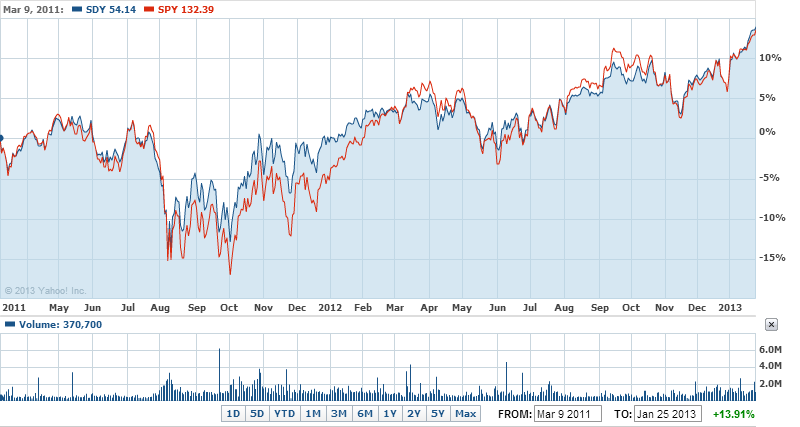
Consider the performance of the SPDR S&P Dividend ETF (SDY) -- which tracks the S&P High Yield Dividend Aristocrats Index -- versus the SPDR S&P (SPY) since the nadir of the financial crisis.


Source: Yahoo! Finance
Just about neck-and-neck over the period, but let's take a look at how they performed in the two years after the low-point in the market:

Source: Yahoo! Finance
For most of this two year period, the SDY steadily outperformed the index. Eventually, however, the index caught up and they've been trading pretty much in-line ever since:

Source: Yahoo! Finance
Though the S&P High Yield Dividend Aristocrats Index may not be the perfect tracker of "quality" dividend stocks, I do consider it a fair proxy. As such, we can gather from this example that quality dividend payers got snapped up fairly quickly in this bull market. By early 2011, the Aristocrats index was likely trading at or near fair value.

Once the quality names have been picked up in the early stages of a bull market, investors looking for a combination of high-yield and quality are normally left needing to compromise one for the other.

This isn't to say there aren't special cases for investors to pick up quality high-yield names at a discount during a bull market -- markets can also overreact to a bad earnings report or temporary sector concerns -- but, as a whole, quality high-yield names are normally snapped up early on.

Scraping the bottom of the barrel

When examining a high-yield stock in this type of market, it's imperative to examine why the stock's yield remains well above the market average. If it possesses market-average risk and growth potential, it stands to reason that its yield should also approximate the market average and that investors should have bid up the stock price by now. If its current yield is still 2x the market average, then, it's probably a good indication that something is wrong with the underlying business -- either it has considerable risk factors or its growth outlook is quite meager. In either case, it probably can't be defined as a "quality" dividend payer.

To further illustrate this concept, let's step into the way-back machine for a moment and travel back to early 2008, near the end of the previous bull market. At the end of 2007, the S&P 500 average dividend yield was 1.89% putting any stock over 3.8% firmly into the high-yield category (my rule-of-thumb is 2x the market average in the U.S.).

I was able to find a helpful table of the highest-yielding Dow 30 stocks as of January 24, 2008 and examine their subsequent five-year dividend growth rates.

Source: CNBC.com, Yahoo! Finance; Altria dividend growth as of June 2008, post-PM spin off.
The dividend-based performance of these shares since the end of the last bull market is certainly mixed, with Altria being the stand-out star, especially when you factor in the performance of Philip Morris International over the period. AT&T and Verizon did reasonably well, too, but you certainly got what you paid for -- high-yield and low dividend growth. As for Pfizer, Citigroup, and GM...the numbers speak for themselves. 

A look at the highest-yielding stocks in the S&P 500 from around the same time is even more troubling, with a number of famous dividend blow-ups found therein. 

Granted, a good percentage of the 1,000+ dividend cuts by U.S. companies in 2008 and 2009 were financials and I don't expect another massive round of dividend cuts in the near future, but the principle holds true that investors should be very skeptical of the highest-yielding stocks in the late stages of a bull market as the "margin of safety" has shrunk considerably.

A cautionary tale

If you've already built your dividend-focused portfolio, this may be a good time to review the highest-yielding names in your portfolio, but it isn't necessarily a screaming sell signal if you have a long time horizon and can afford to be patient. On the other hand, if you're starting to build a dividend-focused portfolio right now or are looking to add new names to your portfolio, proceed with caution when considering high-yield stocks.

As always, thanks for reading and please post any comments below or on our dividend investing community page on Google Plus.

Best,

Todd
@toddwenning on Twitter


Saturday, August 11, 2012

Do Banks Deserve a Place in a Dividend Portfolio?

Earlier this week, we learned that Standard Chartered bank (a stock that I own) was accused by the New York Department of Financial Services (DFS) of engaging in illegal financial transactions with Iran. A worst-case scenario for the bank would be a loss of its New York banking license -- a possibly crippling action since so much money flows through the state of NY, and specifically New York City. The best-case scenario (save a complete dismissal of the allegations) would be a one-time fine and a temporarily tarnished reputation.

Pick your poison

From a dividend investor's perspective, the first case would be far worse as it could impair long-term profitability (indeed, StanChart keeps its accounts in USD) and increase the risk of a dividend cut or perhaps a rights issue. Assuming StanChart did, in fact, do something illegal a hefty a one-time fine should be relatively good news for dividend investors as the company's payout ratio is about 40%, so there's some margin of safety there to absorb a one-time shock. Plus, StanChart has excellent liquidity metrics and an industry-leading capital position. It would have to be a very severe punishment, in my opinion, to put the dividend at risk.

Just a few weeks ago StanChart increased its dividend by 10%, so if the firm knew about the DFS investigation it clearly felt comfortable raising the payout. If management didn't know about the DFS investigation then it either thought it was doing legitimate business in Iran or it was delusional enough to think they would get away with it. If management knowingly conspired or concealed transactions while at the same time heralding its reputation to investors in the recent conference call, that would be enough for me to consider selling my position.

However this plays out, this week's news has raised a number of questions and resurfaced concerns about bank stocks. If this can happen to Standard Chartered -- a self-proclaimed "boring" bank that successfully navigated its way through the financial crisis and had avoided all the scandals that plagued other banks (LIBOR, mis-selling products, etc.) in recent years -- what global bank couldn't this happen to? And more importantly: Do modern banks deserve a place in a dividend portfolio?

Times have changed

Dividend investors have been understandably apprehensive about bank stocks following the financial crisis, as the events clearly put into perspective the reality that modern banks are not the 3-6-3 banks that used to anchor many dividend portfolios. Today's global banks, by contrast, have opaque balance sheets and are more exposed to fat-tail risks (rogue traders, money laundering, etc.) that can quickly impair results.

As a result, today's banks are very difficult to value and you're thus putting a lot of faith in management's ability to make the right decisions. This is exactly why recent events at JP Morgan (the London Whale) and this week's story about Standard Chartered are so disappointing. Both banks have been held up as models for global banking post-financial crisis and the reputations of both firms have been questioned, leaving investors with fewer straws to grasp. If you don't trust the bank's management, it's hard to feel confident about the bank's future.

Worth the trouble?

So why bother with banks when there are plenty of good dividend-paying shares in "less risky" sectors?

I think it's completely understandable for a dividend investor to walk away from bank stocks given events in the last five years, but it's important to keep the following things in mind before making that decision:

1.) If most investors are walking away from bank stocks, that could be an opportunity for contrarian investors to make money in the long-run.

2.) By managing your own portfolio, you get to determine how much exposure you want to certain companies and sectors. If you're cautious about banks but think there's opportunity, make them a small percentage of your portfolio so they can't do permanent damage if things go south.

3.) Sufficiently capitalized banks with good liquidity should be better able to deal with periodic shocks to their business without cutting the dividend.

4.) After the carnage of the financial crisis, banks have a vested interest in building dividend momentum as a sign of improving health.

I should note that this was part of my thesis for Standard Chartered, so time will tell if it holds water.

Look before you leap

StanChart will remain a small part of my portfolio for now, but I don't anticipate adding any other bank stocks to my dividend portfolio in the near-future. Some stocks are just simply not worth the trouble, even if they're potentially undervalued, and I think most global bank stocks fit that bill today. There are plenty of alternative investments out there with more transparent balance sheets, higher dividends, and better cash flows and are easier to value, as well.

Whatever you feel about big bank stocks, be sure to approach them with eyes wide open. Times have changed and today's banks aren't the banks of old -- their dividends are riskier and you should demand a meaningful margin of safety given the heightened uncertainty.