Showing posts with label yield. Show all posts

Saturday, March 8, 2014

Why Dividend Investing Works

"The prime purpose of a business corporation is to pay dividends to its owners. A successful company is one which can pay dividends regularly and presumably increase the rate as time goes on". – Security Analysis, Graham and Dodd
To defenders of the efficient market hypothesis and "rational" markets, dividend-focused strategies can seem to be irrational and an anomaly. Some behavioral economists even chalk dividend strategies up to investor biases such as loss aversion, regret avoidance, and an inability to delay gratification.

Two articles (here and here) by the BAM Alliance's Larry Swedroe from this week summarize these criticisms quite nicely and are worth reading. (If anything, it's important to challenge your beliefs now and then by seeking contrary opinions.)

Yet somehow dividend investing works and has worked over generations and across markets, as investment adviser Tweedy, Browne shows in its papers "The High Dividend Yield Return Advantage" and "What Has Worked in Investing". I've also personally seen it work for many individual investors and in my own portfolio.

Haters gonna hate

In his 2012 letter to shareholders, Warren Buffett made a compelling case as to why Berkshire Hathaway doesn't pay a dividend. Dividend critics often point to Buffett's comments as support for their argument.

What these critics miss, however, is that Buffett was only referring to why his particular company doesn't pay dividends. Berkshire doesn't pay dividends, Buffett reasons, because he thinks he can manage the capital better than shareholders -- and most would agree with him.

Buffett certainly doesn't mind receiving dividends from his portfolio holdings, with most of his largest holdings (Coca-Cola, Exxon, Sanofi, etc.) paying very ample dividends each year. That's because he takes the dividends and reinvests them where he sees the best opportunities.

The fact is that few management teams allocate capital as effectively as Buffett does. As such, they should only have capital they need to reinvest in value-enhancing projects. All extra cash should be returned to shareholders. In addition, by having a certain amount of earnings earmarked for dividends each year, management teams need to focus on investing the remaining capital in an efficient manner.

Indeed, a 2003 article in the Financial Analysts Journal by Arnott and Asness even found a counterintuitive-but-positive relationship between earnings growth and dividend payout ratios:
The historical evidence strongly suggests that expected future earnings growth is fastest when current payout ratios are high and slowest when payout ratios are low....Our evidence contradicts the views of many who believe that substantial reinvestment of retained earnings will fuel faster future earnings growth. Rather, it is consistent with anecdotal tales about managers signaling their earnings expectations through dividends or engaging, at times, in inefficient empire building. 
By investing in firms that pay out a meaningful portion of earnings each year as dividends, then, investors are reducing the risk that management will mis-allocate the capital toward empire-building or value-destructive acquisitions and buybacks.

As Benjamin Graham noted in Security Analysis, "a dollar is worth more to the stockholder if paid him in dividends than when carried to surplus [by the company]." I'd much rather have some of the firm's earnings in my pocket each year than leave it all in the company's coffers. If that money is going to be subsequently misspent, I'd rather it be my own fault than someone else's.

Show me the money

Further, when you invest in a firm that doesn't pay dividends, the only cash flows you can see are the ones the company's accountants says it has. Problem is you can't actually touch any of that cash. Dividends, however, need to be paid in cash and can't be faked. At least for very long.

Firms that are able to consistently generate enough cash to commit to a dividend and are confident enough to raise their payout each year are probably doing something right. A progressive dividend policy also shows a company's shareholders that it views them as partners in its prosperity.

Finally, it may be irrational by traditional finance standards, but focusing on the income return naturally shifts attention away from the short-term price volatility that often causes investors to trade too frequently -- and usually at precisely the wrong time. If focusing on dividends helps investors bear through difficult markets when they would have made emotional trading decisions and racked up high transaction costs in the process, well, I don't see much wrong with that.

Don't get me wrong, total return (capital gains plus income growth) should be the primary long-term objective, but if you can consistently identify quality firms that can grow their payouts each year and buy them at a good-to-fair price, the capital gains should take care of themselves.

Bottom line

You won't find this in any finance textbooks, but dividend investing works precisely because it encourages investors to think like investors -- that is, focus on buying good companies (poorly-run companies can't sustain high dividend growth for very long) at good-to-fair prices and hold them patiently.

Sure, you could do the same with a strategy that doesn't include dividend-paying stocks and sell partial stakes to generate "dividends" as needed. That's much easier said than done, of course, as it requires nerves of steel and a high level of trust that the companies are allocating your capital better than you can.

Dividend investors may indeed be irrational, but I'm content being the irrational guy patiently letting my dividends roll in from well-run companies that I bought at a good price.

What do you think? Please let me know in the comments section below. 

Good reads this week
  • Paul Scott's daily UK small cap report (I highly recommend this - and it's free) - Paul Scott via Stockopedia
  • An interview with behavioral investing expert Michael Mauboussin - Motley Fool
  • Tim Cook doesn't care about "Bloody IRR" - Aswath Damodaran
  • Millennials and the new death of equities - A Wealth of Common Sense
  • Charlie Munger on governance - 1 Raindrop
Quote of the week
A man is rich in proportion to the things he can afford to let alone. - Thoreau 
Stay patient, stay focused.

Best,

Todd
@toddwenning on Twitter

(long BRK.B, KO)


Saturday, November 23, 2013

Investing is an Expectations Game

A thing long expected takes the form of the unexpected when at last it comes. - Mark Twain
In such a low-interest rate environment, why would the market allow companies to trade with 8%+ free cash flow yields -- even after considering a reasonable equity risk premium?

The answer lies in market expectations. For firms with very low free cash flow yields, the market is expecting robust free cash flow growth in the coming years; conversely, for firms with high free cash flow yields, the market might be expecting some free cash flow contraction.

In this graphic, you could justifiably substitute "expectations" for "price".

Naturally, higher market expectations also carry greater risk for market disappointment, and vice versa. As we're evaluating companies for potential investment, this is an important relationship to bear in mind.

To illustrate, I considered the free cash flow yields of some of the largest S&P 500 stocks:

As the list illustrates, the market has relatively lower expectations for Apple than it does Home Depot and lower expectations for Wal-Mart than it does Tesla. This doesn't necessarily mean that Apple is a better investment than Tesla at the moment, but it does mean that, in terms of market expectations, Tesla has much less room to make a mistake than Apple does.

While some stocks with high market expectations -- the Teslas, Amazons, etc. -- could end up being great investments by doing even better than the market currently expects, I think that investors will do have better results, on average, by investing in companies with low market expectations.

Yes, those companies could also do worse than the market expects and fall further in price, but if we conclude that a company's competitive advantages remain intact, the financials are sound, and that they're led by capable management, then there are fairly decent odds that the market's low expectations are wrong.

Whether we're looking for long or short candidates, as investors we want to find where the market's expectations are meaningfully different from our own. Before you begin researching a new company or re-evaluating a current holding, then, it's helpful to determine the company's free cash flow yield to see where it sits on the market expectations spectrum and how your own expectations might differ.

Please note: I recently updated the blog's URL to www.cleareyesinvesting.com from cleareyesinvesting.blogspot.com. Existing bookmarks should work fine, but please let me know if you have any trouble accessing the site. 

Good reads this week:
Quote of the week: 
This paradox exists because most investors think quality, as opposed to price, is the determinant of whether something’s risky. But high quality assets can be risky, and low quality assets can be safe. It’s just a matter of the price paid for them. - Howard Marks, "Everyone Knows"
Happy Thanksgiving!

Best,

Todd
@toddwenning
(long CSCO)


Tuesday, October 15, 2013

Neil Woodford is Going His Own Way

There was big news today in the income investing world as UK fund manager Neil Woodford announced he will leave Invesco Perpetual in 2014, after managing money there for 25 years. 

When I first saw the headline, I thought he might be pulling a Peter Lynch and retiring at the top, but no, he's just setting up his own firm. 

Though Woodford is less well known in the US, his track record at Invesco Perpetual is top-shelf by any standard and he's the industry's best-known (and perhaps best overall) income investor. 

As such, I'm looking forward to hearing more from him and learning more about his investing approach once he's established the new firm. 

For now, I've put together a list of some of my favorite Neil Woodford quotes:
  • I look to invest in businesses that can provide sustainable long-term dividend growth. If I can invest in a businesses when its growth potential is not reflected in the valuation of its shares, this not only reduces the risk of losing money, it increases the upside opportunity.
  • In the short-term, share prices are buffeted by all sorts of influences, but over longer-time periods fundamentals shine through. Dividend growth is the key determinant of long-term share price movements, the rest is sentiment.
  • The economic outlook is tough and will stay so for some time. But the current yield available on selected stocks, combined with dividend growth, can provide decent returns. If you can invest at very low valuations, returns could be even more meaningful. Equity markets offer an attractive yield for investors looking for a better return on capital. This return is not risk free, but a selective and patient approach helps to mitigate risks.
  • I am...absolutely convinced that, in the long-term, valuation and fundamentals of a company are the only things that matter and, like gravity, those things will reassert themselves.
  • We do not focus on short-term performance issues; we focus on the valuation of fundamentals. Our disciplined approach guides us, we believe, to the best opportunities in the stock market and we are very patient investors. We expect our performance to improve when the market begins again to focus, as it inevitably will, on valuation.
  • I am not sure that I have ever really identified a catalyst that has changed anything...the catalyst that I focus on most of all is valuation; valuation is the only catalyst that I really trust.
  • The biggest challenge for me, I suppose, is holding my nerve...But I’m afraid you are condemned by your process and what you believe in, and you have to stick to those as a fund manager or you’ve got nothing to hold on to. We believe in what we are doing. I believe what I’m doing,
  • When we communicate with our investors, what we’re saying is don’t measure us on the basis of 6 months or a year. Look at us over a 3 to 5 year period. And if we can’t deliver those absolute positive returns, then vote with your feet.

Best,

Todd 
@toddwenning


----- Sources:

http://www.telegraph.co.uk/finance/personalfinance/investing/7995201/Neil-Woodford-be-patient-and-selective.html

http://blogs.telegraph.co.uk/finance/ianmcowie/100008092/10-tips-for-investing-for-income-from-neil-woodford-and-others/


http://www.moneymarketing.co.uk/woodford-confronts-his-critics-the-full-interview/1028943.article


http://citywire.co.uk/money/woodford-to-citywire-i-know-i-must-keep-my-nerve/a360771


http://news.bbc.co.uk/2/shared/spl/hi/programmes/money_box/transcripts/money_box_special_24_july_10.pdf

Thursday, October 10, 2013

Better Buying Opportunities Coming for Dividend Investors

In 2005, I distinctly recall perusing the Barnes & Noble business section for a book on dividend investing, only to find just one book that specifically addressed the topic. (There are, um, quite a few more available today on Amazon.com.)

Things changed with the financial crisis, as we know. Interest rates plunged and dividend stocks rapidly became an attractive alternative for income-seeking investors. 


Indeed, the Google Trends chart for the search term “dividend stocks” illustrates the changes in sentiment from 2004 to present quite nicely:


Source: Google Trends

Naturally, the financial services industry responded to strong investor demand for dividends by launching dividend-themed ETFs, ETNs, and funds to attract assets. Some are more creative than others, but when there's a revenue-weighted dividend ETF (not kidding), you know folks are running out of ideas.

Fortunately, it seems we're past the "peak" for dividend valuations, investor interest appears to be turning elsewhere, and more long-term buying opportunities could thus present themselves.

"Non-dividend stocks have outperformed dividend stocks in the S&P 500 over a one year timeframe. Prior to this period, nonpayers had underperformed dividend stocks since late 2009."  - FactSet Dividend Quarterly, September 2013
Just this week, in fact, I started a position in Coca-Cola -- my first buy this year for the dividend sleeve of my portfolio -- and found it interesting that the stock was yielding over 3% for the first time since 2010. 

Though low interest rates may be around a little longer, the prospect of rising interest rates in the coming years should at least limit further multiple expansion for higher-yielding dividend stocks. In the event of a market pull-back and considering the robust dividend growth we've seen in the last three years, I would expect to see more quality 3% to 5% yields coming available. 

Stay focused and patient out there.

Best,

Todd
@toddwenning

Good reads this week


Quote of the Week
"My father was very sure about certain matters pertaining to the universe. To him, all good things -- trout as well as eternal salvation -- come by grace and grace comes by art and art does not come easy." -- Norman Maclean, "A River Runs Through It" 

Saturday, September 21, 2013

The Ten Points of Income Investing

1. Income investing is a separate and distinct strategy

It's not growth, it's not value -- income comes first. (See: The Income Investor's Manifesto)

2. Discipline and patience are behavioral prerequisites 

Great dividend-producing portfolios are built over decades, not weeks and months. It's critical to keep short-term market moves in perspective. (See: Making Each Investment Count)

3. Insist on owning dividend-paying companies with economic moats

You'll save yourself a lot of trouble if you own firms with durable competitive advantages. Read this book to learn how to recognize an economic moat.

4. Keep transaction costs to a minimum

Ideally below 1% per year. Remember: you can only compound what you keep.

5. Beware of unrealistic yields

If a yield seems too good to be true, it probably is. There might be something wrong with a stock that carries a yield more than twice the index average. (See: Ultra High Yield = Ultra High Risk)

6. Don't be afraid to sell, but do so for the right reasons

Trading and income investing don't mix. Take an investor's perspective and aim to hold for at least three years. (See: A Simple Guide for Selling Stocks)

7. Have a dividend reinvestment strategy

How you manage the regular cash flows from your dividend portfolio can have a tremendous impact on your long-term returns. (See: 5 Keys for Reinvesting Dividends)

8. Think globally, but be mindful of extra costs 

There are great dividend opportunities in foreign markets, but be aware of possible withholding taxes in the company's home country.

9. Stay away from companies drowning in debt

Companies with too much debt become beholden to creditors and the dividend can come under pressure if the creditors aren't satisfied.

10. Take a portfolio perspective

A dividend strategy isn't comprised of one or two stocks, but rather a group of stocks assembled to achieve specific objectives and goals. (See: 5 Rules for Building a Dividend-Focused Portfolio)

What do you think? Any points to add? Please let me know in the comments section below.

Best,

Todd
@toddwenning on Twitter

Saturday, July 27, 2013

10 Investing Lessons Learned

Ten years ago this week, I started my first job in the investment industry and it seemed a fairly decent occasion to reflect upon some of the key principles I've learned thus far in my career. 


  1. Patience is paramount. Having worked with a number of ultra-high net worth individuals, I learned that the common theme in their portfolios was patience. Not a single one was on the phone with us multiple times a day placing trades. Sure, the clients had questions about their holdings now and then, but they stuck to the agreed-upon strategies and were letting time do the work. In some cases, they still held onto shares of companies that their grandparents had bought half a century earlier and were simply letting the dividends roll in year after year.

  2. Always consider incentives. Investors typically spend the majority of their research time investigating the company's income statement, balance sheet, and cash flow statement. While the information on these statements is obviously important, I've found that far less time is spent researching executive incentives and pay packages, which can be found in the annual proxy statement (14A) in the U.S. (In some markets, this information can be found in the annual report.) Unlike the historical financial statements tell you what's already happened, reviewing management's incentives can help you understand how management will steer the company going forward.

  3. You need to have a good information filter. With so much financial information available today, it's essential to know what's important and what isn't. This comes with experience, but a good rule-of-thumb is to focus on information pertinent to a company's competitive positioning within the industry.

  4. The best investments you make are usually the ones where your get the most criticism. With investing, it rarely pays to be on the side of the cheerleaders. Indeed, some of the best investments I've made received initial criticism -- and the more passionate the criticism, the better; conversely, when I hear someone say "good call" about a recent investment, I start to wonder if I missed something important. Being able to stand alone in your convictions is a key ingredient to successful long-term investing.

  5. There’s no substitute for dividends. Despite the recent enthusiasm for "total yield" and similar measures that lump in buybacks and debt repayments with dividends, the bottom line is that only dividends put cash in shareholders' pockets today. None of the aforementioned successful investors that I worked with talked about how they were "living off their buybacks" and none of them manufactured their own dividends by selling partial stakes every quarter. That works in theory, but less so in practice.

  6. Process matters more than short-term results. Whether you're evaluating a mutual fund manager or reviewing your own strategies, short-term returns are largely a matter of luck rather than skill. Instead, focus on the investment selection process, as over time the process will have a more meaningful impact on returns. If you're going to review performance, pay closer attention to five-year returns as that's typically enough time to reveal the success of an investment strategy. Legendary investor Philip Fisher asked his clients for three years before they judged his results. Whichever time frame you prefer, the point is to not focus on quarter-to-quarter or even year-to-year results as a measure of investor skill.

  7. Keep costs to a minimum. The more capital you have to compound, the better. Some trading costs are unavoidable, but the key is to keep them to a minimum. A good rule-of-thumb is to keep commissions below 2% of each investment (e.g. invest more than $500 at a time if commissions are $10) -- and ideally much less. It's also smart to practice good capital location to keep a lid on tax costs -- i.e. to the extent possible, keep dividend paying stocks in tax-advantaged accounts like IRAs and your non-dividend paying stocks in taxable accounts.

  8. Actively seek feedback. Investing without feedback can slow your learning process, create or enable biases, and increase the odds of permanent losses as you're more likely to commit avoidable mistakes. If you can, find a trusted investing partner to run your ideas by -- and ideally one that isn't afraid to be critical and provide feedback. Even if you're confident in your abilities as an investor and think you can go it alone, consider the Warren Buffett/Charlie Munger partnership -- even the most capable investors of our time value the benefits of an investing partnership.

  9. Keep good records. A common denominator among the investors I admire is they meticulously keep track of each investment's thesis and their progress using spreadsheets and/or notebooks. The purpose of this exercise is to reduce biases that may skew your memory of why you bought the stock in the first place. Similarly, it can help you understand when the time is right to sell the stock.

  10. Read, think, and teach. Another common denominator among great investors is that they're bookworms. Sure, devour as many annual reports, investing books, and shareholder letters as you can, but you can also get valuable perspective from non-finance books. The Tao Te Ching, for example, provides some great insight about the value of patience. As you improve your knowledge base, don't forget that investing isn't an easy topic and there are many people seeking reliable answers. When its prudent -- and you know the answer -- don't shy away from opportunities to teach and help others become better investors. As the Roman philosopher Seneca said, "Welcome those whom you yourself can improve. The process is mutual; for men learn while they teach."

If you have any lessons to share from your investing experience, I'd like to hear them! Please share them in the comments section below or on Twitter @toddwenning. 

Best,

Todd
@toddwenning on Twitter


Wednesday, June 19, 2013

Can a Total Shareholder Yield ETF Work?

A rare mid-week post, but earlier today I read an interesting article on Forbes about the Cambria Shareholder Yield ETF (SYLD), which was based on an interview with the Cambria CIO. So I decided to dig into the story a little this evening.

The SYLD ETF is slightly different from the growing number of dividend ETFs on the market today in that it doesn't focus solely on dividends, but also includes buybacks and debt reduction in its algorithm. From the Cambria site:
The Cambria Shareholder Yield ETF is an actively managed fund that employs the manager's quantitative algorithm to select U.S. listed companies that show strong characteristics in returning free cash flow to their shareholders. Specifically, SYLD invests in 100 stocks with market caps greater than $200 million that rank among the highest in (a) paying cash dividends, (b) engaging in net share repurchases, and (c) paying down debt on their balance sheets.
It's a novel approach for sure and investors should certainly pay attention to buybacks and debt when analyzing individual companies. (I particularly liked the CIO's mention in the Forbes article about watching out for high-yielding stocks that are also increasing their share count. A good tip!)

Though I give Cambria credit for trying something different, after reading the SYLD ETF's prospectus, I'm not sure it will work as an ETF or formula-based strategy.

As we discussed in an earlier post, though buybacks are becoming a larger part of corporate distributions, I don't think a "total yield" measure can replace dividend yield.

Source: Birinyi Associates and FRB Z.1.
The obvious reason is that buybacks remain a choice rather than a commitment. In a given year or two, a company could dramatically pull back on buybacks and the "total yield" shrivels up. (It's true that a company could also cut its dividend, but this would be much harder to do given different shareholder expectations.)

To Cambria's credit, they are looking to invest in companies with a systematic approach to buybacks, but this puts enormous faith in management's ability to have a good buyback process. How Cambria measures this in its security selection algorithm is not disclosed, but it seems to be a challenging task using a strictly quantitative process.

As we've seen, many companies end up buying back stock when they have excess cash...which also tends to be when their share price is higher. In my experience, I've come across very few companies with a rational and disciplined approach to buybacks.

I'm also not clear on why debt reduction should be considered part of "shareholder yield." At face value, less debt on a balance sheet seems desirable, but it's also possible for companies to be underlevered. In this case, companies should take on more debt to reduce their overall cost of capital. Further, and more to the point, the cash return is to bondholders and not shareholders.

Perhaps the answer to the net debt reduction question lies in the prospectus, which notes that the measure of dividends, net buybacks, and net debt reduction cash flows:
"in isolation, is inadequate to determine the attractiveness of its equity securities, considered together these measures have the potential to result in the construction of a portfolio of companies with better cash flows, stronger growth potential and higher yield characteristics. Considering these measures together, which comprise shareholder yield, may result in a more attractive investment portfolio." (My emphasis)
If I were considering SYLD I would ask whether or not net debt reduction was simply a "plug" figure in the formula that made the algorithm look more predictive than dividends and net buybacks alone. Best case is the ETF is looking for firms that can return cash via dividends and buybacks without borrowing, but if that's the case, it should be more explicit in the prospectus.

I realize I've been critical of most of the new ETFs out there, but I also think it's important to look behind the alluring stories in the ETF launch material. Ultimately, I remain convinced that investors are best served building their own dividend-focused portfolio one stock at a time with thorough research.

I'm interested to hear what you think, so please let me know in the comments below or on Twitter @toddwenning.

Best,

Todd


Saturday, January 26, 2013

The Most Dangerous Time to Pick High-Yield Stocks

The most dangerous time to pick high-yield stocks is in the late stage of a bull market, which I believe we're in today.

One of the oldest investment adages is that "bull markets climb a wall of worry" and that has certainly been true of this market. Despite all the various crises -- Greece, the Eurozone, fiscal cliffs, debt ceilings, Manti Te'o's girlfriend, etc. -- many major global markets are at or near five-year highs. 


From a dividend investor's perspective, however, it's precisely the worry that provides the opportunities to buy quality high-yield shares -- defined loosely here as companies with strong balance sheets, plenty of dividend cover, a good track record of raising dividend payouts, and sustainable competitive advantages -- at discounted prices.


As markets rally and the worry dissipates, however, dividend yields naturally go in the opposite direction and the number of good opportunities dries up.


Quality rallies early

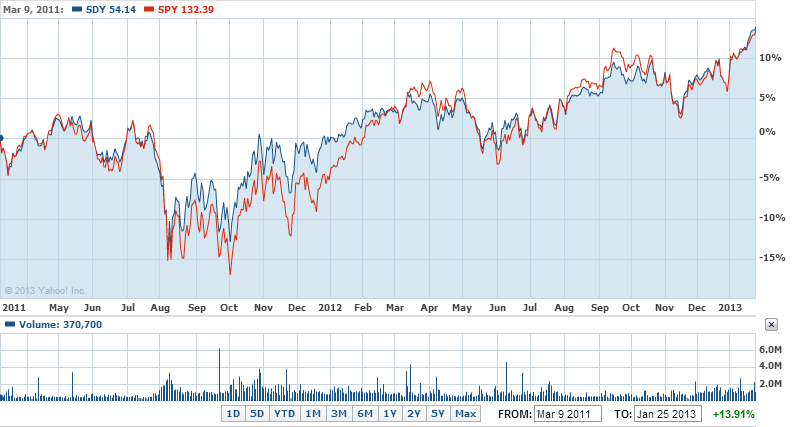
Consider the performance of the SPDR S&P Dividend ETF (SDY) -- which tracks the S&P High Yield Dividend Aristocrats Index -- versus the SPDR S&P (SPY) since the nadir of the financial crisis.


Source: Yahoo! Finance
Just about neck-and-neck over the period, but let's take a look at how they performed in the two years after the low-point in the market:

Source: Yahoo! Finance
For most of this two year period, the SDY steadily outperformed the index. Eventually, however, the index caught up and they've been trading pretty much in-line ever since:

Source: Yahoo! Finance
Though the S&P High Yield Dividend Aristocrats Index may not be the perfect tracker of "quality" dividend stocks, I do consider it a fair proxy. As such, we can gather from this example that quality dividend payers got snapped up fairly quickly in this bull market. By early 2011, the Aristocrats index was likely trading at or near fair value.

Once the quality names have been picked up in the early stages of a bull market, investors looking for a combination of high-yield and quality are normally left needing to compromise one for the other.

This isn't to say there aren't special cases for investors to pick up quality high-yield names at a discount during a bull market -- markets can also overreact to a bad earnings report or temporary sector concerns -- but, as a whole, quality high-yield names are normally snapped up early on.

Scraping the bottom of the barrel

When examining a high-yield stock in this type of market, it's imperative to examine why the stock's yield remains well above the market average. If it possesses market-average risk and growth potential, it stands to reason that its yield should also approximate the market average and that investors should have bid up the stock price by now. If its current yield is still 2x the market average, then, it's probably a good indication that something is wrong with the underlying business -- either it has considerable risk factors or its growth outlook is quite meager. In either case, it probably can't be defined as a "quality" dividend payer.

To further illustrate this concept, let's step into the way-back machine for a moment and travel back to early 2008, near the end of the previous bull market. At the end of 2007, the S&P 500 average dividend yield was 1.89% putting any stock over 3.8% firmly into the high-yield category (my rule-of-thumb is 2x the market average in the U.S.).

I was able to find a helpful table of the highest-yielding Dow 30 stocks as of January 24, 2008 and examine their subsequent five-year dividend growth rates.

Source: CNBC.com, Yahoo! Finance; Altria dividend growth as of June 2008, post-PM spin off.
The dividend-based performance of these shares since the end of the last bull market is certainly mixed, with Altria being the stand-out star, especially when you factor in the performance of Philip Morris International over the period. AT&T and Verizon did reasonably well, too, but you certainly got what you paid for -- high-yield and low dividend growth. As for Pfizer, Citigroup, and GM...the numbers speak for themselves. 

A look at the highest-yielding stocks in the S&P 500 from around the same time is even more troubling, with a number of famous dividend blow-ups found therein. 

Granted, a good percentage of the 1,000+ dividend cuts by U.S. companies in 2008 and 2009 were financials and I don't expect another massive round of dividend cuts in the near future, but the principle holds true that investors should be very skeptical of the highest-yielding stocks in the late stages of a bull market as the "margin of safety" has shrunk considerably.

A cautionary tale

If you've already built your dividend-focused portfolio, this may be a good time to review the highest-yielding names in your portfolio, but it isn't necessarily a screaming sell signal if you have a long time horizon and can afford to be patient. On the other hand, if you're starting to build a dividend-focused portfolio right now or are looking to add new names to your portfolio, proceed with caution when considering high-yield stocks.

As always, thanks for reading and please post any comments below or on our dividend investing community page on Google Plus.

Best,

Todd
@toddwenning on Twitter


Sunday, December 16, 2012

3 Reasons Why Most Dividend ETFs Will Fail

Today, there are some 50 dividend ETFs in the U.S. market with approximately $50 billion under management between them. A few years ago, there were only a handful of them to choose from. Thanks to the growing investor demand for income, however, they have rapidly attracted assets and, naturally, new ones seem to spring up each month.

In five years' time, I expect most of them to have gone the way of the Dodo, or at least have altered their mandates, as investors will eventually either a) be underwhelmed by their performance and/or b) find lower-risk alternatives for generating income and consequently take their money elsewhere.

Here are three reasons why I think that will be the case.

#1) They're basically closet-S&P 500 trackers with higher expense ratios. 

Most of the highly-liquid, higher-yielding stocks (the Exxons, GEs, etc.) are already found in the S&P 500, yet you'll likely pay at least 0.3% for a dividend-themed ETF versus 0.1% or less for an S&P 500 tracker. 

As this one-year performance chart comparing SPY with five of the larger dividend ETFs by AUM illustrates, you haven't been getting what you paid for. In fact, SPY was the best-performing of the lot. 

Source: Google Finance, as of Dec. 15, 2012
#2) Serious dividend investors can replicate the strategy on their own at a lower cost. 

An individual investor with a firm understanding of stock selection and portfolio construction could put together a diversified basket of individual dividend-paying stocks on their own -- that also better matched his or her risk tolerance and objectives -- and do so at a lower cost in the longer-term assuming they don't actively trade. 

Experienced dividend investors already know they can build their own portfolios and aren't the ones pumping money into dividend-themed ETFs. As such, I suspect that most of the money that's been invested in dividend ETFs over the past eighteen months has come from financial advisors hoping to eek a little more income out of their clients' portfolios in a low-rate environment, and that once interest rates rise (or tax rates change), they'll gradually switch their clients back to fixed income products.

#3) Dividend ETFs will be slow to adjust to changes in the market environment. 

It seems that each new dividend ETF that hits the market claims to have some kind of edge over the others -- "quality", "dividend dogs", and so on -- and they've all done backtests to show how their strategy would have worked over the past x number of years. 

The thing to keep in mind is that the dividend environment has changed dramatically over the past ten years and will likely change even more in the next ten. Since 2003, for instance, U.S. dividend tax rates were dropped to historic lows, the financial crisis led to hundreds of dividend cuts, and buybacks eclipsed dividends as the primary way that companies return shareholder cash. 

Looking forward, U.S. dividend taxes will go up in 2013 and that will certainly have a meaningful effect on corporate dividend policies in the coming years. All this is to say that dividend ETFs that construct their portfolios based on strategies that worked in the past may find that their formulas do not work going forward. 

My rule of thumb here is, the more "boutique" the dividend theme or strategy in an ETF, the more likely it will struggle to adjust to changing market conditions.

Bottom line

This is not to say that all dividend ETFs are doomed or unworthy of investment, but to be careful about which ones you choose. A number of them will be survivors, and they'll likely be the ones with the lowest expense ratios and broadest diversification. Sadly, those are also usually the ones that most-closely track the S&P 500 and offer the lowest yields. 

If you really want to give one of these new specialized dividend-themed ETFs a try, do proceed with caution. Don't focus on backtested performance, but focus on the fund's stock selection process. 

See you in 2013!

This will likely be my last post in 2012, so I wanted to say "thank you" for reading this year and to wish you a great holiday season. 

I also recently started up a dividend investing community on Google Plus, which you can join by clicking here (free with a Google account). It would be great to see you there!

Best,

Todd
@toddwenning on Twitter


Sunday, October 21, 2012

An Important Misunderstanding About Dividends

My interest in dividends began during a previous job in which I helped manage the portfolios of ultra-high net worth individuals.

In many cases, the account owners had bought their stocks decades earlier, never touched them, reinvested their dividends, and were now living off the dividends from those investments without needing to touch the principal. The principal was then typically passed onto children and grand-children who were always, of course, appreciative of grandpa's or grandma's wise investment decisions.

This approach to investing was radically different from what I had previously understood investing to be -- that is, trading and taking bets on the next "big" thing. Patient dividend investing seemed a much more reasonable (and rational) approach for an individual investor and the bulk of my own investments today remain aligned with this valuable strategy.

As I learned more about dividend investing, I came across a number of academic studies and books that suggested that the vast majority of long-term returns from stocks were attributable to dividends. Indeed, these studies fit nicely with my experiences working with the wealthy investors who harnessed the power of dividends to build their family fortunes.

Looking more closely at these studies, however, I found that they assumed 100% dividend reinvestment, which overstates the contribution of dividends to long-term returns.

Earth to the ivory tower...

The 100% reinvestment assumption is simply not practical. Taxes, for one, can prevent full reinvestment as can commissions, the inability to reinvest in fractional shares, and an investor's decision to spend or save the dividend rather than reinvest it.

A 2011 paper by Legg Mason's Michael Mauboussin sheds much light on this topic and correctly emphasizes the distinction between the equity rate of return (price appreciation plus dividend yield) and the capital accumulation rate (returns including reinvested dividends).

Mauboussin provides two helpful formulas to help us understand the math behind total shareholder return (TSR).

1.) TSR = g + (1+g)*d

Where:
           g = the annual price appreciation rate
           d = dividend yield

This TSR formula assumes 100% reinvestment of dividends and is likely the one used in the previously referenced academic studies. To illustrate, a stock that's growing at 7% per year and has a 4% starting dividend yield should generate TSR of 11.28% annualized (0.07 + (1 + 0.07)*0.04).

TSR equals the capital accumulation rate (CAR) only when there's 100% reinvestment. The following formula shows the CAR when there isn't 100% dividend reinvestment. It's the same formula as the first, with a slight modifier that incorporates rate of reinvestment.

2.) CAR = g + (1+g)*d*r

Where:
           r = % reinvested

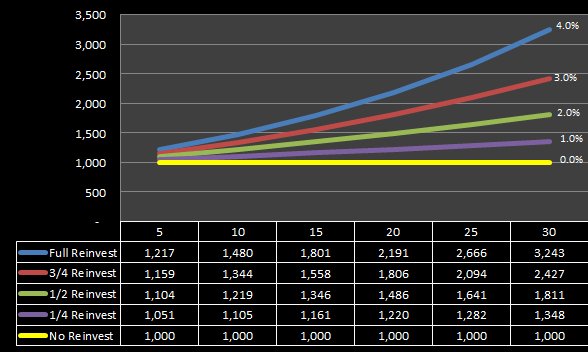
To show how various rates of reinvestment can dramatically affect long-term returns, the following chart and table assume a $1,000 investment in a stock with a starting dividend yield (d) of 4% and annual price appreciation rate (g) of 7% at various rates of reinvestment over time.


As you can see, anything less than full reinvestment results in a lower CAR, and price appreciation rather than dividends accounts for a larger and larger percentage of the results. If the investor chooses to reinvest nothing and instead chooses to consume the dividend, the only source of growth is price appreciation.

To further illustrate the importance of price appreciation in returns, let's assume an annual price appreciation rate (g) of 0% at various rates of reinvestment.


Over 30 years assuming 100% reinvestment, a $1,000 investment in a stock with an initial dividend yield of 4% and price appreciation of 7% will be worth $24,690; if price appreciation is 0% it will be worth $3,243. When there's no price growth, you're just purchasing additional shares.

In other words, while we can clearly see the importance of reinvesting dividends in enhancing the benefits of compounding growth, we can also see that price appreciation matters more than the oft-cited studies suggest.

This isn't a dividend downer 

By no means should this be taken as a knock on the power of dividends. Rather, it shows that investors also need to pay attention to price appreciation and valuation. Dividends alone don't drive returns. 

While the academic studies over-emphasize and perhaps misrepresent the contribution of dividends to long-term shareholder returns, the studies remain an important part of the discourse about dividends and illustrate quite clearly how dividends enhance the benefits of compounding growth. Their lessons should still be heeded.

The more fully you can reinvest each dividend received, the higher your potential longer-term returns. A few ways that you can maximize your reinvestment rate are to hold your dividend paying stocks in tax-advantaged accounts like IRAs (US) and ISAs (UK), to compare your broker's reinvestment fees (if any) and policies (do they allow fractional reinvestment?) versus others, and to evaluate your reinvestment strategy.

Thanks for reading! Please post any questions or comments below.

Best,

Todd
@toddwenning on Twitter

Note: In the original post, I mislabeled CAR in the second formula and in the examples. It has now been updated. Apologies for the confusion. 

Saturday, October 13, 2012

Should We Do Away With Dividend Yield?

We may not like it, but buybacks are here to stay. Management teams prefer buybacks for a number of reasons, even though those reasons may not always be in the best interests of their shareholders.

So ingrained are buybacks in today's market that some have called for an end to the classic definition of dividend yield (dividends per share / share price) to be replaced with a "modified" or "total" yield that includes buybacks ( (dividends + buybacks per share) / share price). 

Indeed, Standard & Poors now includes a "dividend & buyback yield" column in its quarterly update on S&P 500 distributions. Ready or not, it's becoming a more commonly-used metric.

The game has changed...

The total yield approach is somewhat instructive as it helps explain a number of things that we've seen in the 30 years since Congress (via rule 10b-18) allowed companies to make greater use of buybacks. 

The major thing total yield helps explain is why dividend yields over the past 30 years remain well-off historical averages. The chart below shows the dividend yield of the S&P 500 between 1960 and 2011 and compares it with the total yield of all U.S. companies since 1985 when buybacks started becoming a meaningful way of returning shareholder cash. 

Source: S&P (via Aswath Damodaran) and Birinyi Associates and FRB Z.1. (via Michael Mauboussin) 

Recognizing there's only a slight difference between the 1960-2011 and 1985-2011 data, the major difference between the red and blue lines is buyback yield. Put in this perspective, the decline in dividend yield can be rationalized as a paradigm shift toward alternative ways of returning shareholder cash.

In fact, it shows that companies have become even more generous with distributions than in the past. 

(Don't break out the party hats just yet...)

The next chart provides more granularity for the total yield period and shows the rise of buybacks as the primary means of returning shareholder cash between 1985 and 2011.


Source: Birinyi Associates and FRB Z.1.  
As you can see from these two charts, buybacks have only recently become a truly driving force in the total yield equation. Until 2004, dividends had accounted for the majority of distributions -- even during the dotcom boom.

Predictably, the buyback trend since 2004 has largely followed the market. When the market has been good and companies feel flush, buybacks have increased, and vice versa. Curiously -- and sadly -- as Michael Mauboussin points out here, M&A activity has generally followed this path, as well:

Indeed, M&A and buybacks follow the economic cycle: Activity increases when the stock market is up and decreases when the market is down. This is the exact opposite pattern you’d expect if management’s primary goal is to build value.  (His emphasis)
One shining example of this principle in action has been Hewlett-Packard, which repurchased $36 billion of its stock between 2008 and 2011.

Its current market cap is $28 billion.

Long-term HPQ shareholders certainly don't feel any richer despite the $36 billion buybacks that should have been used to enhance shareholder value -- or in part distributed to shareholders as special cash dividends. Worse, most of the buybacks were fueled by borrowings and HPQ's debt/equity ratio increased from 13% in 2007 to 76% in the most recent quarter.

...but common sense remains common sense

There are companies that make prudent use of buybacks and no, I'm not completely opposed to them; however, general market data shows that, on average, buybacks are value destructive.

For this reason alone, I cannot accept the idea that we should do away with dividend yield and replace it with a total yield metric that includes buybacks. The two types of returning shareholder cash are simply not apples-to-apples. 

The total yield metric is certainly instructive, but given the differences between dividends and buybacks and the track record of companies destroying value using buybacks, it's critical to keep dividend yield and buyback yield separate.

Hope you're having a great weekend! Thanks for reading.

Best,

Todd


Sunday, August 19, 2012

Introducing the Dividend Compass

When it comes to equity analysis, a lot of attention is paid to valuation -- and rightly so, as your investing career will likely be a short one if you consistently overpay for assets.

Surprisingly, however, there's typically little attention paid to dividend analysis, which usually begins and ends with a glance at the dividend payout ratio (or dividend cover). As long as the company is earning more than it's paying out, the thinking goes, all is well with the dividend; conversely, if the company is paying out about the same amount as (or more than) it's earning, the dividend is at risk.

There's more to it

While the payout ratio is important, in my experience, the main causes of a dividend cut are factors other than a high dividend payout ratio (or low dividend cover). Indeed, a high payout ratio is usually the result of past events and trends that have been in place for a number of years.

In fact, more times than not, the need to strengthen the balance sheet is the cited reason for a dividend cut -- creditors and ratings agencies get worried about a lack of cash flow and large dividends become an easy target for freeing up cash. In turn, a weak balance sheet is often the result of a deterioration in business strength over a number of years -- margins have contracted, growth has slowed, and free cash flow has dried up -- paired with over-borrowing or over-spending.

Early diagnosis is the key

So rather than just look at the dividend payout ratio, it seems prudent to take a more holistic approach to dividend analysis by considering other factors that contribute to dividend health, such as:
  • Sales growth: Sales are the life-blood of a company. If sales are drying up, that puts added pressure on profits and cash flows and thus the dividend, too.
  • Interest coverage (EBIT/interest expense): If a company is having trouble paying the interest on its debt, there's a greater chance that its creditors will get worried and raise the company's cost of borrowing, which could reduce net income. In a worst-case scenario, the dividend could be cut to accelerate the repayment of principal. 
  • Net debt/EBITDA: This is a common measure ((Debt-Cash)/EBITDA) that creditors and ratings agencies use to determine credit quality and it's commonly used as a metric in debt covenants. A firm that has borrowed too much or is struggling to pay down its debt relative to its profitability is more likely to have a risky dividend.
  • Dividend growth rate: A slowing dividend growth rate could be a sign that the company is less confident in its future growth potential. Eventually, all companies' dividend growth rates decline, but you want to see a steady decrease over many years and not a sharp drop.
  • Earnings cover: Even though I don't think it's the best measure of dividend health, earnings cover (Net Income/Dividends Paid) remains the most common metric cited by both companies and investors alike, so it should be considered in any dividend analysis.
  • Free cash flow cover: Free cash flow cover ((CFO-CapEx)/Dividends Paid) is a better measure of dividend health than earnings cover because companies don't pay out earnings -- they pay out cash. As such, I'd rather look at a company's cash flows than net income.
  • Operating margin: A company whose margins are contracting could be facing increased competitive pressures or becoming less efficient. When this occurs, less money falls to the bottom line and to cash flows and the dividend can become riskier. Cyclical companies' margins will naturally ebb and flow. In those cases, use rolling 5-year margins to account for the business cycle.
  • Return on equity: Companies that are unable to sustainably generate returns above their cost of equity are likely destroying shareholder value and usually have lower growth potential. Neither are good things from a dividend perspective.
Dividend Compass Tool 
 
With this framework in mind, I tried my hand at a new (and hopefully improved) spreadsheet model for rating the health of a company's dividend. I'm calling it the Dividend Compass, and you can access and download it for free by clicking here.

(It's hosted on Google Docs for sharing purposes, but you can download it to Excel by clicking on File>Download As>Excel on the top left hand corner of the Google Docs page. Once you've downloaded it, you can make changes. If something doesn't work, please let me know in the comments section below.)

To get started, all you need to do is enter a few years' worth of key financial datapoints (sales, debt, etc.) -- all publicly available data -- on the Inputs tab and then click on the Dividend Compass tab.


The Dividend Compass (DC) will rate the company's dividend health based on metrics derived from your entries, with a 5 being a perfect score and 1 being the lowest. The overall score is based on the weighted average scores of the eight metrics and the default weights are based on what I believe to be the most important metrics. You can change them to fit your approach as long as they sum to 100%.


The DC will also grade the dividend going back a few years and provide a 5-year average score that will help you identify trends in the dividend's health. A falling score in any of the categoreis, for instance, may indicate a trouble spot that's worth looking into.

A few things to remember

I can't stress enough that the DC should not be used as a buy/sell indicator nor is it meant to be the final word on any stock. It's simply a research tool to help you tell the difference between a healthy dividend from a risky one, using a more holistic approach than traditional methods. Further research is always necessary before making a trading decision. 

Dividend yield is not included as a graded metric in the DC. All else equal, I would expect higher yielding names to have lower scores and vice versa.

Finally, the DC is still in early days, so if you notice a bug or see room for improvement, please post a comment below. Questions and criticisms are always welcomed, too.

Hope you had a nice weekend.

Best,

Todd
@toddwenning on Twitter
(long JNJ, the default example in the DC spreadsheet)