Showing posts with label portfolio management. Show all posts

Sunday, November 5, 2017

13 Investing Gems from Anthony Bolton

One of the unexpected benefits of working overseas early in my career was learning about investors I probably wouldn't have come across until much later on. British investors like Nick Train, Neil Woodford, and Terry Smith, for example, have influenced my investment philosophy in some fashion.

The subject of today's post, Anthony Bolton, also fits into this group. Bolton ran the Fidelity Special Situations Fund in the U.K. for 28 years ending December 2007, posting incredible annualized returns near 19.5% while at the helm. 


Suffice it to say, there's a lot we can learn from Bolton.

His tenure coincided with another famous Fidelity fund manager, Peter Lynch, whose foreword to Bolton's book, Investing Against the Tide: Lessons From a Life Running Money was alone worth the price of admission. 

Here are a few lines from Lynch's foreword:
  • To succeed in investment you have to work at it. Watch for the importance of hard work as you turn these pages. Note how often going the extra mile on research and analysis is what accounts for sustained success. Keep your eye on that theme and you'll see that what the media call investment "genius" actually springs from a base of sustained, unending research - which, in turn, yields a decisive information edge. That edge, plus steady nerves, flexibility, good judgement and a complete lack of bias or prejudgement is what has enabled Anthony Bolton to deliver record-setting compound returns for decades. (my emphasis)
  • I stress hard work, an information edge and flexibility because few cliches have done more damage to investors' wealth than the phrase 'play the market'. 
  • What distinguishes investment winners...is the willingness to dig deeper, search more widely and keep an open mind to all ideas - including the idea that you might have made a bad call. He or she who turns over the most rocks, looks over the most investment ideas, and is unsentimental about pas choices is most likely to succeed.
The book's worth a read for intermediate and advanced investors. The organization is messy, unfortunately, but there's rich content inside. Bolton's recollection of company meetings serve up some great lessons. Those managing money will appreciate his thoughts on portfolio management, as well.

Here are 13 gems I double-highlighted while reading the book.
  1. Often, I ask myself a very simple question: 'How likely is this business to be around in ten years' time and to be more valuable than today?' It's surprising how many businesses fail this test.
  2. Sometimes the names of the institutional shareholders (of a company) will carry information because there are some I rate more highly than others and if one or two I rate are on the list that's a positive. 
  3. The ultimate commendation is when a company talks positively about a competitor...In fact, as a general rule, when a company says the opposite of what you expect them to say I put a double weight on it.
  4. (Good managers) tend to be fanatical about the business, working long hours and demanding high performance and excellence from their team and they are reasonably self-assured and on top of what they do without being arrogant.
  5. Seeing through spin is one of the most important aspects of the job. 
  6. I prefer thinking in levels of conviction rather than in price targets.
  7. The (stock) price itself influences behaviour - falling prices create uncertainty and concern, rising prices create confidence and conviction. Understanding this is a really important part of investing.
  8. A portfolio should, as nearly as possible, reflect a 'start from scratch' portfolio...One of the things I do each month is an exercise that helps me measure my conviction. On a piece of paper I write five headings across the top: "strong buy", "buy", "hold", "reduce" and "?"
  9. I don't normally make large adjustments to the size of my holdings in one go, my moves are incremental.
  10. When I've analysed the biggest mistakes I've made over the years they have nearly always been in companies with poor balance sheets.
  11. Thinking like a short specialist is a good discipline for most portfolio managers...If you are aware of what might go wrong in a company (knowing the counter investment thesis) one may be able to spot before others the fact that it is going wrong. 
  12. It's rare that you only get one chance to make a trade at a specific level.
  13. I've always thought that the best environment in which a fund manager could perform well was one in which they didn't know how they were doing.
==
Earlier this year, I was invited by Harriman House publishers to contribute a chapter to their forthcoming book, Harriman's New Book of Investing Rules: The do's and don'ts of the world's best investors

I contributed a chapter on dividend investing and can't wait to read the 50+ sets of rules written by some of my favorite investors including Vanguard founder Jack Bogle, Nick Train, and today's subject, Anthony Bolton.  

Stay patient, stay focused.

Best,

Todd
@toddwenning


The opinions expressed here are the author's and not those of his employer. For a full disclaimer, please click here. 

Saturday, April 25, 2015

How to Invest for Your Kid's Education

After posting some investing advice for my new son a few months ago, a number of readers contacted me to ask how I planned on investing on his behalf - in particular, how I planned on investing for his education.

Frankly, I didn't have a great answer to give, so I contacted my buddy Ryan Vogel, CFP® at Private Wealth Management Group to get his opinion. 

Ryan and I started our careers at Vanguard on the same day and we've remained good friends ever since. Not only is he one of the nicest guys in the business, he's also one of the most trustworthy - a valuable commodity in the finance world. Decent golfer, too. 

Rather than keep Ryan's responses* to myself, we thought it made sense to share them with you, too, as they address most of the questions I received. (This is somewhat of a U.S.-centric discussion, but non-U.S. readers should still get something out of it.)


TW: There are a lot of education savings vehicles out there for parents to consider - 529s, Education Savings Accounts, UGMA/UTMAs. Which is the best vehicle for minimizing taxes for the parents and making sure the kids get the most out of the savings plan and financial aid?

RV: While saving money on taxes is important, it should not be the primary consideration on how to invest your money for education.  The first consideration should be the goals you have for your money.  What is the purpose of this investment?  How much control do I want to retain?  Each account has their pros and cons.

529s - I deal with these the most with my clientele.

Pros
  • Tax free growth
  • No limitations based on earned income
  • Very high limits on contributions
  • Potential state tax deductions (depends on state, in PA you get a deduction for amount contributed regardless of what plan you choose).
  • 5 year averaging for gift tax avoidance
  • Can transfer money between beneficiaries that are siblings or even cousins (ideal for grandparents)
Cons
  • Can only trade once per calendar year
  • Limited investment options
  • Must be used for post-secondary education costs. 
ESAs are a better fit for saving for high school education.  However, the contribution limit is only $2,000 and there are income limitations.  This means that if you earn too much you can’t contribute.  You have a much greater choice of investment options in this type of account and the money grows tax free.

UTMAs are taxable custodial accounts.  You have complete investment flexibility but you receive no tax benefits. 

I didn’t address the financial aid part of the question because I really don’t have experience in this area.  Most of the clients I work with have incomes too high to qualify for any aid.  Also, colleges and universities have become much more detailed in vetting the finances of applicants. 

TW: Which states have the best 529 plans? How should parents evaluate them and their fund options? 

RV: Nowadays there are plenty of good options.  Ohio, Michigan, Utah, New York, Kansas, etc.  Since 529’s have trading restrictions, the best thing to focus on is costs.  What are the administrative fees?  What are the expense ratios for the underlying funds in each plan?  What funds are included in their age based option?  What are the asset allocations used in the age based options?  How about the options available other than age based?  

Then there are other aspects such as administration.  How user friendly is their website?  Is it easy to setup auto withdrawal/deposit?  Personally, I chose Ohio.  I like their aggressive age based asset allocation and the funds and administrative costs are low.  The funds are mainly Vanguard and now DFA, which I am happy about.  Their website is just OK, but I don’t go on except for when I make ad hoc contributions.  Mostly I just stick with my monthly contribution and increase the amount whenever I get a raise.

TW: What about setting up trusts for the kids' education?

RV: Setting up trusts just for education can be costly and in some cases unnecessary.  If you own a 529  you still retain control and ownership of the assets regardless of age (even though the contribution is considered a completed gift for tax purposes).  

I find education trusts are used mainly as an incentive as part of someone’s estate plan.  Basically, the trusts state that the student “go to school and graduate” or they don’t get access to an inheritance or other gift from their family.  Another aspect to keep in mind with trusts is that if you don’t have someone to act as trustee and need a corporate trustee, the trust needs to be large enough (usually at least $750k) for a corporate trustee to want to assume liability.   

TW: How should parents think about asset allocation for their kids' education funds? How should we think about making adjustments as the kids approach college?

RV: Be aggressive.  Education inflation is averaging 6%.  In order to retain purchasing power you will need to take risk.  Risk tolerance is important to consider, since you don’t want to get scared and sell at the wrong time, but investing in a stock heavy asset allocation makes sense.  

As you approach college or any goal where you know the money will be needed, you will want to become more conservative.  However, remember that you don’t need all of the money on the first day of college.  The four years (or more) will go fast, but that doesn’t mean you need to be 100% bonds and cash on the first day of school.

TW: What's the best type of account to use if I just want to buy a few stocks for my kids to teach them about investing and help them build non-education related wealth?
RV: UTMAs are the best in this situation.  There are no investment restrictions and the money can be used for anything. Just be careful how much income is generated so as to avoid paying any “kiddie tax.”

*Please note that Ryan's answers are only highlights and are not all encompassing or to be construed as specific advice.

How do you invest for your kids' education? Please let me know in the comments section below or on Twitter @toddwenning. (I ended up going with the Ohio 529 plan and started with the Wellington Fund option. I also plan on buying him a few stocks - the subject of a future post.)

Stay patient, stay focused.

Best,

Todd


Subscribe to Clear Eyes Investing by Email

Saturday, April 18, 2015

Investing in Your Best Ideas

One of the things I struggle with the most as an investor is knowing how much capital I should put behind each of my investments.

Indeed, the biggest mistakes of my investing career haven't been those where I've lost a little money, it's been the ones where I haven't invested enough in my top ideas.

Case in point, in the summer of 2010, I started researching TradeStation, an online brokerage company here in the U.S. that I thought was significantly undervalued. I did a lot of due diligence, spoke with the CFO, users of the product, etc. and thought the odds were favorable that I'd make money on the investment. It was the best idea I'd had in some time.

Feeling confident in my thesis, I bought some shares for my portfolio.

Fast-forward eight months and TradeStation gets acquired, producing a 60% gain on my investment.

Good news, right?

A 60% gain is nothing to sneeze at, of course, but the problem was I only put 1% of my portfolio behind my idea. While the investment had a positive impact on my returns, it also didn't have a very meaningful impact. It was akin to getting the proverbial "fat pitch" only to lay down a bunt instead of taking a full swing.

What I took from this experience was that you need to invest enough in your best ideas that they can have a meaningful impact on your long-term performance, up to the point where you start to lose sleep over the size of the position.

This will vary by each investor's ability to handle risk. Some investors don't mind putting 20% or 30% behind a single stock while others will blush at a 5% position. Either way, it's important to give your best ideas a chance to make a difference.

How do you approach position sizing? Let me know on Twitter @toddwenning or in the comments section below.

If you're going to be in Omaha for the Berkshire Hathaway meeting on May 2 and would like to meet up, please drop me a line!

Related posts:

Stay patient, stay focused.

Best,

Todd


Subscribe to Clear Eyes Investing by Email


Friday, July 11, 2014

Why You Should Probably Own Fewer Stocks

I think the average person could know three or four or five companies very well. They could lecture on those three or four or five companies, and if one or two of 'em becomes attractive, they buy 'em...You have to know the story. - Peter Lynch 
Pardon the Saved by the Bell reference. Couldn't resist.
For many individual investors, finding the time to do proper research is a real challenge. After higher-priority commitments to family, friends, work, etc., if you have time to read one annual report a week, you're doing pretty well. 

In my experience, an investor doing all the work himself or herself needs between five to ten hours a year to keep good tabs on each stock they already own -- i.e. reading quarterly reports, the annual report, conference call transcripts, etc. Thoroughly researching a brand new stock typically takes over ten hours.

So, how much time do you have to dedicate to stock research? With 50 hours a year to spare -- about an hour a week -- you might be able to cover ten companies, but it's likely fewer. If you can outsource some research to a reliable newsletter or research service, then perhaps a few more. 

The important thing is to maximize the returns on your research time. In other words, make sure you're giving each holding the appropriate amount of research time and make sure you're investing enough in each idea that it's worth the time you're spending on it.

To illustrate, I recently reviewed my own portfolio and concluded that I owned more companies than I could adequately cover in my spare time. In addition, I had a number of 2% or 3% positions that weren't likely to have a major impact on my returns, even if they did very well.

With the market still riding high, it seemed like an ideal opportunity to go through my portfolio and eliminate smaller holdings. I started by asking myself the following questions for each stock I own:

  • Did you read the company's latest annual report/10-K?
  • Did you vote your shares and read the annual proxy statement?
  • Is the company's competitive position getting better or worse?
  • Where is the company in its business cycle?
  • What was the company's last major capital allocation decision (M&A, special dividend, etc.)?

  • If I answered "no" or "I don't know" to at least one of the above questions, it was clear that I wasn't thinking about my investment like a part-owner of the business. Either I needed to re-commit to researching the company or it was time to sell the position.

    There are a number of clear benefits to owning a smaller, more manageable number of stocks. For one, you'll have fewer holdings set on autopilot, more time to focus on your best ideas, and more money to put behind your best ideas.
    You might even realize better performance. A 2008 study by Ivkovic, Sialm, and Weisbenner found the following:
    Among households with portfolios large enough to diversify among many stocks, if desired, the holdings and trades made by those focusing their attention on a few securities tend to perform significantly better than the investments made by those diversifying across many stocks.
    Diversification is important, of course, but much of your core diversification needs can be met through low-cost index funds and ETFs. For the portion of your portfolio directly invested in stocks, however, it's important to have sufficient time and resources to monitor each company and make the most of the research time you have.

    What do you think? Let me know in the comments below or on Twitter @toddwenning.

    What I've been reading this week:
    Stay patient, stay focused.

    Best,

    Todd


    Saturday, October 19, 2013

    An Easy Mistake Made by Dividend Investors

    Dividend investing can seem deceptively easy. If you want to generate, say, a 5% yield from your dividend portfolio, you only need to buy a group of stocks that provide a weighted average yield of 5%. Then just sit back and watch the money roll in.

    Or so the thinking goes.

    And, yes, you may indeed receive your desired dividend income if you follow this strategy, but constructing a portfolio in this manner without attention to valuation could end up costing you in the longer-term.

    Consider two investors that each invested $100,000 in dividend portfolios with 5% starting yields. Over the course of ten years each investor realizes annual dividend growth of 3%. The first investor (blue line) bought stocks that were considerably overvalued and subsequently lost 20% in capital value in year one; alternatively, the other (red line) invested in stocks that were undervalued and gained 20% in capital value in year one.

    After the year one corrections to fair value, both portfolios grow at 8% per year through year 10.


    At the end of ten years, both portfolios generated the same amount of dividend income ($57,319), but their ending capital values are nearly $80,000 apart ($159,920 vs. $239,880). It's hard to imagine that the two investors would feel equally good about their performance even though they realized equal dividend income over the ten year period.

    To further my point, if both investors decided to liquidate their dividend portfolios in year 10 and invested their capital in bonds with 5% coupons, the first investor would receive annual payments of $7,996 while the second investor would receive $11,994 per year until maturity.

    This is an admittedly simple example, but it illustrates an important point about the hidden costs of not paying attention to valuation in income investing. Ultimately, capital growth matters.

    Valuation avoidance (Photobucket)
    Whether you use relative valuation methods (i.e. comparing P/E ratios, etc.) or absolute valuation methods (i.e. dividend discount models, discounted cash flow models, etc.), the important thing is to fully consider the price you're paying and the value you're getting from each investment. Get to know the businesses you'd like to invest in, understand what drives their performance, and don't rely on a single metric -- in this case, dividend yield -- to guide your buying decisions.

    Good dividend investing eschews complexity, but that doesn't mean it's supposed to be easy.

    Good reads this week

    Quote of the week
    A mildly non-conventional investment approach, emphasizing a business approach to security selection, gives some opportunity for long-term results slightly above average without corresponding increase in investment risk. - Warren Buffett
    If you think this article may be of interest to a friend or colleague, feel free to forward it, and let me know if you have any questions about topics discussed. 

    Best,

    Todd 
    @toddwenning

    Tuesday, October 15, 2013

    Neil Woodford is Going His Own Way

    There was big news today in the income investing world as UK fund manager Neil Woodford announced he will leave Invesco Perpetual in 2014, after managing money there for 25 years. 

    When I first saw the headline, I thought he might be pulling a Peter Lynch and retiring at the top, but no, he's just setting up his own firm. 

    Though Woodford is less well known in the US, his track record at Invesco Perpetual is top-shelf by any standard and he's the industry's best-known (and perhaps best overall) income investor

    As such, I'm looking forward to hearing more from him and learning more about his investing approach once he's established the new firm. 

    For now, I've put together a list of some of my favorite Neil Woodford quotes:
    • I look to invest in businesses that can provide sustainable long-term dividend growth. If I can invest in a businesses when its growth potential is not reflected in the valuation of its shares, this not only reduces the risk of losing money, it increases the upside opportunity.
    • In the short-term, share prices are buffeted by all sorts of influences, but over longer-time periods fundamentals shine through. Dividend growth is the key determinant of long-term share price movements, the rest is sentiment.
    • The economic outlook is tough and will stay so for some time. But the current yield available on selected stocks, combined with dividend growth, can provide decent returns. If you can invest at very low valuations, returns could be even more meaningful. Equity markets offer an attractive yield for investors looking for a better return on capital. This return is not risk free, but a selective and patient approach helps to mitigate risks.
    • I am...absolutely convinced that, in the long-term, valuation and fundamentals of a company are the only things that matter and, like gravity, those things will reassert themselves.
    • We do not focus on short-term performance issues; we focus on the valuation of fundamentals. Our disciplined approach guides us, we believe, to the best opportunities in the stock market and we are very patient investors. We expect our performance to improve when the market begins again to focus, as it inevitably will, on valuation.
    • I am not sure that I have ever really identified a catalyst that has changed anything...the catalyst that I focus on most of all is valuation; valuation is the only catalyst that I really trust.
    • The biggest challenge for me, I suppose, is holding my nerve...But I’m afraid you are condemned by your process and what you believe in, and you have to stick to those as a fund manager or you’ve got nothing to hold on to. We believe in what we are doing. I believe what I’m doing,
    • When we communicate with our investors, what we’re saying is don’t measure us on the basis of 6 months or a year. Look at us over a 3 to 5 year period. And if we can’t deliver those absolute positive returns, then vote with your feet.

    Best,

    Todd 
    @toddwenning


    ----- Sources:

    http://www.telegraph.co.uk/finance/personalfinance/investing/7995201/Neil-Woodford-be-patient-and-selective.html

    http://blogs.telegraph.co.uk/finance/ianmcowie/100008092/10-tips-for-investing-for-income-from-neil-woodford-and-others/


    http://www.moneymarketing.co.uk/woodford-confronts-his-critics-the-full-interview/1028943.article


    http://citywire.co.uk/money/woodford-to-citywire-i-know-i-must-keep-my-nerve/a360771


    http://news.bbc.co.uk/2/shared/spl/hi/programmes/money_box/transcripts/money_box_special_24_july_10.pdf

    Saturday, September 21, 2013

    The Ten Points of Income Investing

    1. Income investing is a separate and distinct strategy

    It's not growth, it's not value -- income comes first. (See: The Income Investor's Manifesto)

    2. Discipline and patience are behavioral prerequisites 

    Great dividend-producing portfolios are built over decades, not weeks and months. It's critical to keep short-term market moves in perspective. (See: Making Each Investment Count)

    3. Insist on owning dividend-paying companies with economic moats

    You'll save yourself a lot of trouble if you own firms with durable competitive advantages. Read this book to learn how to recognize an economic moat.

    4. Keep transaction costs to a minimum

    Ideally below 1% per year. Remember: you can only compound what you keep.

    5. Beware of unrealistic yields

    If a yield seems too good to be true, it probably is. There might be something wrong with a stock that carries a yield more than twice the index average. (See: Ultra High Yield = Ultra High Risk)

    6. Don't be afraid to sell, but do so for the right reasons

    Trading and income investing don't mix. Take an investor's perspective and aim to hold for at least three years. (See: A Simple Guide for Selling Stocks)

    7. Have a dividend reinvestment strategy

    How you manage the regular cash flows from your dividend portfolio can have a tremendous impact on your long-term returns. (See: 5 Keys for Reinvesting Dividends)

    8. Think globally, but be mindful of extra costs 

    There are great dividend opportunities in foreign markets, but be aware of possible withholding taxes in the company's home country.

    9. Stay away from companies drowning in debt

    Companies with too much debt become beholden to creditors and the dividend can come under pressure if the creditors aren't satisfied.

    10. Take a portfolio perspective

    A dividend strategy isn't comprised of one or two stocks, but rather a group of stocks assembled to achieve specific objectives and goals. (See: 5 Rules for Building a Dividend-Focused Portfolio)

    What do you think? Any points to add? Please let me know in the comments section below.

    Best,

    Todd
    @toddwenning on Twitter

    Tuesday, July 9, 2013

    A Closer Look at Peter Lynch's "Principles"

    Even though I've been a big fan of Peter Lynch's classic One Up on Wall Street for many years, I'd for some reason never thought to follow up with his next book, Beating the Street.

    I'm glad I finally did. Whereas "One Up" focuses mainly on the retail investor's strategy of "buying what you know", this book is more of a review of his years running Fidelity Magellan and it spends more time on the investing processes he used to produce some of the best long-term returns in mutual fund history.

    The one drawback to the book for the reader in 2013 is that some of the case studies are a bit dated and it could use updated commentaries. Still, it's the investing research process that's particularly compelling and that is fairly evergreen.

    Throughout the book Lynch peppers in 21 "Peter's Principles", or quick lessons from his investing career. I've outlined them here and added some commentary.

    #1 When the operas outnumber the football games three to zero, you know there is something wrong with your life.

    Lynch knew his work-life balance was skewed when he found he didn't have enough time to enjoy his family and things that he loved. Not an investing lesson, per se, but a good reminder that professional success isn't everything.

    #2 Gentlemen who prefer bonds don't know what they're missing.

    At the time the book was published in the early '90s, bonds were very popular and Lynch lists reason after reason why investors with a long time horizon should prefer stocks to bonds in just about every market scenario (with one exception below). Indeed, Lynch reminds investors that fixed income is exactly that:
    Whereas companies routinely reward their shareholders with higher dividends, no company in the history of finance, going back as far as the Medicis, has rewarded its bondholders by raising the interest rate on a bond...The most a bondholder can expect is to get his or her principal back, after its value has been shrunk by inflation.
    #3 Never invest in any idea you can't illustrate with a crayon.

    One of Lynch's gems. Before you buy a stock, try drawing a diagram of how cash comes in and cash goes out. It's not always as easy as it seems. If it's a struggle, best pass on the idea.

    #4 You can't see the future through a rearview mirror.

    The market is forward-looking. What happened in the news or in the market last year, last month, or even yesterday has little bearing on a stock's price a year from now. As such, try to keep the right perspective on things like historical performance and backtests.

    #5 There's no point paying Yo-Yo Ma to play a radio. 

    Lynch makes the point in the book that investors can build a portfolio of Treasuries more cheaply than by paying fund managers to do the same thing. There's no point in paying someone top-dollar to do something you can do yourself.

    #6 As long as you're picking a fund, you might as well pick a good one.

    Pretty self-explanatory. I'd only add that when researching a fund, focus on the team's investing process and less on recent performance.

    #7 The extravagance of any corporate office is directly proportional to management's reluctance to reward its shareholders.

    Every dollar spent on office luxuries not needed to effectively run the business is a dollar less that could go in your pocket as a dividend or reinvested in the business. If you can visit the company's offices to determine the level of extravagance, great -- if not, try using Google Maps street-level view to get a sense of the location and perhaps a view of the building itself. Golden statues and ostentatious fountains...bad sign.

    #8 When yields on long-term government bonds exceed the dividend yield of the S&P 500 by 6 percentage points or more, sell your stocks and buy bonds.

    As unlikely as this scenario may seem today, it could happen down the road. Lynch's point is that if long-term Treasuries are yielding far above the dividend yield on stocks, it's likely a sign that stocks are overbought (and yields have fallen) and bonds are probably providing more attractive intermediate-term returns. In any case, we have a really long way to go to reach a 6% gap today.

    Source: Economagic.com
    #9 Not all common stocks are equally common. 

    Lynch was often criticized for owning so many stocks at Magellan that the fund was a "closet" index fund with an expensive price tag. His point here is that as long as the stocks he owns have a strong investment thesis, it shouldn't matter if he owns 10, 100, or 1,000 of them.

    #10 Never look back when you're driving on the autobahn.

    This is probably literal advice, as Lynch shares his story about being nearly run over by a Mercedes on the autobahn. A bit of a head-scratcher for inclusion in the list of principles, I must say.

    #11 The best stock to buy may be the one you already own.

    This is something that I myself struggle with now and again. The "thrill of the chase" is a powerful force for investors and we're always looking for the next exciting opportunity, but you've already bought the stocks in your portfolio for a reason -- and if those reasons are still good, why not buy more (at the right price)? After all, these should be stocks you already know well and you won't need to start from scratch and invest many hours researching the next stock. This isn't always the right strategy, but it's one to keep in mind.

    #12 A sure cure for taking a stock for granted is a big drop in the price.

    Even the highest quality companies can have nasty surprises. Don't set any investment on auto-pilot; aim to check-in every quarter or at least twice a year to make sure your thesis is still intact.

    #13 Never bet on a comeback while they're playing "Taps."

    It's important to look for unloved and under-appreciated stocks, but some stocks have fallen for good reason. If you're going to make a strong bet against market sentiment, have a reasonable thesis and don't buy a beaten-up stock simply because it's beaten-up. It could get even worse...

    #14 If you like the store, chances are you'll love the stock.

    This is true...to a degree. Before buying the stock of a company whose stores I like, though, I want to make sure that the market hasn't already priced-in other consumers feeling the same way. I much prefer buying my favorite retailers in the event of an indiscriminate market sell-off.

    #15 When insiders are buying, it's a good sign -- unless they happen to be New England bankers. 

    Lynch talks about New England bankers buying their own stocks all the way down, but in most cases insider buying is a positive signal. Ideally, you want to see executives using personal cash in the open market (not so much exercising stock options) and purchasing a meaningful amount. Executives are naturally optimistic about their companies' prospects, but it's much less common for them to put their own money up behind this sentiment. When they do, take note.

    #16 In business, competition is never as healthy as total domination. 

    Popular stocks tend to be those with high-growth potential, but Lynch rightly points out that these companies often attract significant competition. Slower-growth companies, on the other hand, can be much better buys if they also happen to command a large share of the market, have significant pricing power, etc.

    #17 All else being equal, invest in the company with the fewest color photographs in the annual report.

    Somewhat similar to #7, companies that feel the need to put on a good face for shareholders by using fancy pictures and interactive features in their annual reports might be trying to cover up deteriorating operations. (Enron's 1999 annual report, for example, was colorful.) Not always the case, of course, but something to bear in mind.

    #18 When even the analysts are bored, it's time to start buying.

    Industries that have lagged market rallies or posted underwhelming growth for a year or two may be overlooked by investors currently focused on recent winners.

    #19 Unless you're a short seller or a poet looking for a wealthy spouse, it never pays to be pessimistic.

    Bears will be right once every few years and pessimists often have elaborate and alluring theses, but as Josh Brown has noted, "Count the perma bears on the Forbes 400 list or the amount of pessimists who run companies in the Fortune 500. You will find none." When it comes to being a long-term investor, it pays to be optimistic -- especially if you can remain optimistic when others are becoming more pessimistic. Granted this is easy to say, harder to do.

    #20 Corporations, like people, change their names for one of two reasons: either they've gotten married, or they've been involved in some fiasco that they hope the public will forget.

    Be wary of companies that have changed their name. It's probably the same pig...only with a new shade of lipstick.

    #21 Whatever the queen is selling, buy it. 

    Look for opportunities to buy recently-privatized businesses. These opportunities are more likely to be found  today in emerging markets.

    A few more good quotes...

    Shareholders play a major role in a fund's success or failure. If they are steadfast and refuse to panic in the scary situations, the fund manager won't have to liquidate stocks at unfavorable prices in order to pay them back.

    Cyclicals are like blackjack: stay in the game too long and it's bound to take back all your profit.

    Stockpicking is both an art and a science, but too much of either is a dangerous thing...If you could tell the future from a balance sheet, then mathematicians and accountants would be the richest people in the world by now.

    When a company buys back shares that once paid a dividend and borrows the money to do it, it enjoys a double advantage. The interest on the loan is tax-deductable, and the company is reducing its outlay for dividend checks, which it had to pay in after-tax dollars.

    Have you read Beating the Street? If so, what did you think?

    Best,

    Todd
    @toddwenning


    Saturday, June 29, 2013

    5 Ways to Avoid Permanent Losses

    Earlier this week on Twitter, Carl Richards (+Behavior Gap) -- who you really should be following if you're not already -- started an interesting conversation about investing and risk:


    As Homer Simpson would say: "It's funny 'cause it's true." And for two reasons. First, and most obviously, because statistics can be confusing and second because the industry's statistical definition of risk is too academic and doesn't get at the root of what keeps investors up at night.

    Finance textbooks and trading models might define risk in statistical terms based on volatility, but such definitions are incomplete for patient, business-focused investors.

    If we've done our homework, purchased a stock at a good price, and remain confident in our thesis, how the quoted stock price moves on a day-to-day or month-to-month basis shouldn't be of any concern. You'd be hard pressed to find an investor who cared about the following type of volatility:

    Different definition

    Instead, what long term investors are really concerned about is permanent loss of capital. As the name implies, a permanent loss of capital differs from a temporary loss of capital that's due to market volatility and it occurs when an investment's value has declined so much that getting back to break-even within a few years is unlikely. Effectively, an unrecoverable loss.

    As the following table shows, when a stock loses 40% or more of its value, it takes a substantial recovery to get back to even:


    To put this in some perspective, consider a 50% paper loss on an investment. While it's certainly possible for the stock to stage a huge recovery and double in value over the next year, if we assume historical equity returns of 9% per year, it would take about eight years for the stock to get back to even on a nominal basis.

    Though you might patiently wait for this to happen, that investment from eight years prior was in essence wasted capital that could have been invested more effectively elsewhere.

    How to avoid such a fate

    Invest long enough and you'll have a permanent loss of capital at some point. It's bound to happen as we're all human, but it's critical to make large losses infrequent events as they can seriously weigh on your portfolio's long-term returns.

    Here are five things you can apply to your investment process to reduce the likelihood of permanent losses of capital:

    1. Buy with an appropriate margin of safety. This may seem obvious -- buy a stock for less than it's worth and you'll reduce the odds of permanent losses -- but (a) we as investors are prone to buying into stories, individual attributes (high yields, low PE, etc.), or a hot tip and fully disregarding valuation and (b) when we do adequate valuation work we often make inappropriate margin of safety assessments before buying. 

    What I mean by the latter point is that we should demand a larger margin of safety when buying a business with a higher degree of uncertainty and vice versa. It's one thing to buy a large cap defensive company like Coca-Cola with a 10% discount to fair value, but a 10% margin of safety isn't likely enough for a small-cap stock in a cyclical industry. You're more likely to lose your shirt feeling too confident in your assessment of the small-cap's value than you are of Coca-Cola, so a larger margin of safety is required.

    2. Use a checklist. Online investing and low-commissions, as great as they are, also cater to impulsive decision-making. It's easy to read a few company filings, get excited about what you're reading, and press the buy button. As a check on your emotions, make use of an investing checklist (like this one) before placing a trade. If the latest idea doesn't check off all the boxes on your list, figure out why that's the case. There could be a good explanation, but if there's not, consider passing on the idea for now. 

    The important point here is that checklists can save us from making stupid decisions based on emotion. For more checklist ideas, +Stockopedia has a great set of checklists based on different styles of investing.

    3. Ask the right questions. Before buying a stock, fully consider alternative theses and perhaps more importantly what other bulls are thinking, as this can save you from missing giant red flags and blindly following the herd. In other words, we need to ask different questions than our fellow market participants if we aim to make good investments and avoid permanent losses of capital. 

    Howard Marks of Oaktree Capital calls this "second-level thinking". In his book The Most Important Thing, he provides the following example:
    First-level thinking says, "It's a good company; let's buy the stock." Second-level thinking says, "It's a good company, but everyone thinks it's a great company, and it's not. So the stock's overrated and overpriced; let's sell."
    Each investment will have specific questions to ask, but if you're looking for a good place to start, here's my list of five questions to ask before buying a stock.

    4. Focus on trends in competitive advantages. The market has become incredibly focused on the short-term. For example, the average stock mutual fund turnover rate have jumped from an average of 17% between 1945 and 1965 (implying an average holding period of about five years) closer to 100% today (implying an average holding period of about one year). Naturally, then, market participants seek short-term information advantages -- e.g. "Will this company beat next quarter's consensus estimates?" -- at the expense of gathering helpful long-term information.

    My fear is that much of what passes as incremental information adds little or no value, because investors don't properly weight information, rely on unsound samples, and fail to recognize what the market already knows. In contrast, I find that thoughtful discussions about a firm's or an industry's medium- to long-term competitive outlook are extremely rare.
    Spend more time in your research process thinking about where this company might be three- to five-years from now. A simple way to get started is with a "SWOT" analysis -- listing the company's strengths, weaknesses, opportunities, and threats. Then ask how the company might enhance its current strengths, reduce its weaknesses, capitalize on opportunities, and respond to competitive threats.

    5. Avoid cult stocks & sectors that are in the market spotlight. Jason Zweig had a great post for the WSJ this week on his mission to save investors from themselves by helping them avoid speculative periods in the market. Also the commentator on the revised edition of Benjamin Graham's Intelligent Investor, Zweig has the rare ability to spot market irrationality and stand behind his convictions even when they're not popular at the time.

    The perennial refrain from critics is: You just don’t get it. Internet stocks / housing / energy prices / financial stocks / gold / silver / bonds / high-yield stocks / you-name-it can’t go down. This time is different, and here’s why.
    But this time is never different. History always rhymes. Human nature never changes. You should always become more skeptical of any investment that has recently soared in price, and you should always become more enthusiastic about any asset that has recently fallen in price. That’s what it means to be an investor. (My emphasis)
    Bingo. Can't say it any better than that. Consistently follow this advice and it will help you avoid permanent losses of capital.

    Bottom line

    The best definition of risk for long-term investors isn't volatility, but permanent loss of capital. Every investor will have permanent losses over his or her investing career, but the key is to minimize their frequency. Hopefully these five suggestions will help you avoid some of them. 

    Good reads/videos this week:
    Have a great weekend!

    Best,

    Todd
    @toddwenning

    Saturday, January 26, 2013

    The Most Dangerous Time to Pick High-Yield Stocks

    The most dangerous time to pick high-yield stocks is in the late stage of a bull market, which I believe we're in today.

    One of the oldest investment adages is that "bull markets climb a wall of worry" and that has certainly been true of this market. Despite all the various crises -- Greece, the Eurozone, fiscal cliffs, debt ceilings, Manti Te'o's girlfriend, etc. -- many major global markets are at or near five-year highs. 


    From a dividend investor's perspective, however, it's precisely the worry that provides the opportunities to buy quality high-yield shares -- defined loosely here as companies with strong balance sheets, plenty of dividend cover, a good track record of raising dividend payouts, and sustainable competitive advantages -- at discounted prices.


    As markets rally and the worry dissipates, however, dividend yields naturally go in the opposite direction and the number of good opportunities dries up.


    Quality rallies early

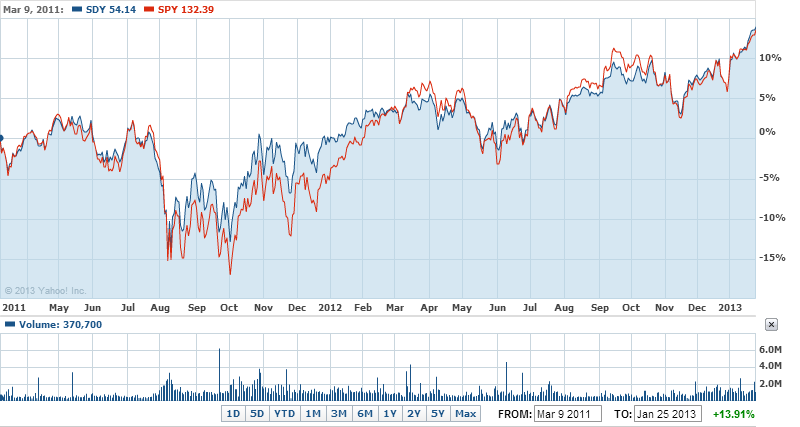
    Consider the performance of the SPDR S&P Dividend ETF (SDY) -- which tracks the S&P High Yield Dividend Aristocrats Index -- versus the SPDR S&P (SPY) since the nadir of the financial crisis.


    Source: Yahoo! Finance
    Just about neck-and-neck over the period, but let's take a look at how they performed in the two years after the low-point in the market:

    Source: Yahoo! Finance
    For most of this two year period, the SDY steadily outperformed the index. Eventually, however, the index caught up and they've been trading pretty much in-line ever since:

    Source: Yahoo! Finance
    Though the S&P High Yield Dividend Aristocrats Index may not be the perfect tracker of "quality" dividend stocks, I do consider it a fair proxy. As such, we can gather from this example that quality dividend payers got snapped up fairly quickly in this bull market. By early 2011, the Aristocrats index was likely trading at or near fair value.

    Once the quality names have been picked up in the early stages of a bull market, investors looking for a combination of high-yield and quality are normally left needing to compromise one for the other.

    This isn't to say there aren't special cases for investors to pick up quality high-yield names at a discount during a bull market -- markets can also overreact to a bad earnings report or temporary sector concerns -- but, as a whole, quality high-yield names are normally snapped up early on.

    Scraping the bottom of the barrel

    When examining a high-yield stock in this type of market, it's imperative to examine why the stock's yield remains well above the market average. If it possesses market-average risk and growth potential, it stands to reason that its yield should also approximate the market average and that investors should have bid up the stock price by now. If its current yield is still 2x the market average, then, it's probably a good indication that something is wrong with the underlying business -- either it has considerable risk factors or its growth outlook is quite meager. In either case, it probably can't be defined as a "quality" dividend payer.

    To further illustrate this concept, let's step into the way-back machine for a moment and travel back to early 2008, near the end of the previous bull market. At the end of 2007, the S&P 500 average dividend yield was 1.89% putting any stock over 3.8% firmly into the high-yield category (my rule-of-thumb is 2x the market average in the U.S.).

    I was able to find a helpful table of the highest-yielding Dow 30 stocks as of January 24, 2008 and examine their subsequent five-year dividend growth rates.

    Source: CNBC.com, Yahoo! Finance; Altria dividend growth as of June 2008, post-PM spin off.
    The dividend-based performance of these shares since the end of the last bull market is certainly mixed, with Altria being the stand-out star, especially when you factor in the performance of Philip Morris International over the period. AT&T and Verizon did reasonably well, too, but you certainly got what you paid for -- high-yield and low dividend growth. As for Pfizer, Citigroup, and GM...the numbers speak for themselves. 

    A look at the highest-yielding stocks in the S&P 500 from around the same time is even more troubling, with a number of famous dividend blow-ups found therein. 

    Granted, a good percentage of the 1,000+ dividend cuts by U.S. companies in 2008 and 2009 were financials and I don't expect another massive round of dividend cuts in the near future, but the principle holds true that investors should be very skeptical of the highest-yielding stocks in the late stages of a bull market as the "margin of safety" has shrunk considerably.

    A cautionary tale

    If you've already built your dividend-focused portfolio, this may be a good time to review the highest-yielding names in your portfolio, but it isn't necessarily a screaming sell signal if you have a long time horizon and can afford to be patient. On the other hand, if you're starting to build a dividend-focused portfolio right now or are looking to add new names to your portfolio, proceed with caution when considering high-yield stocks.

    As always, thanks for reading and please post any comments below or on our dividend investing community page on Google Plus.

    Best,

    Todd
    @toddwenning on Twitter